
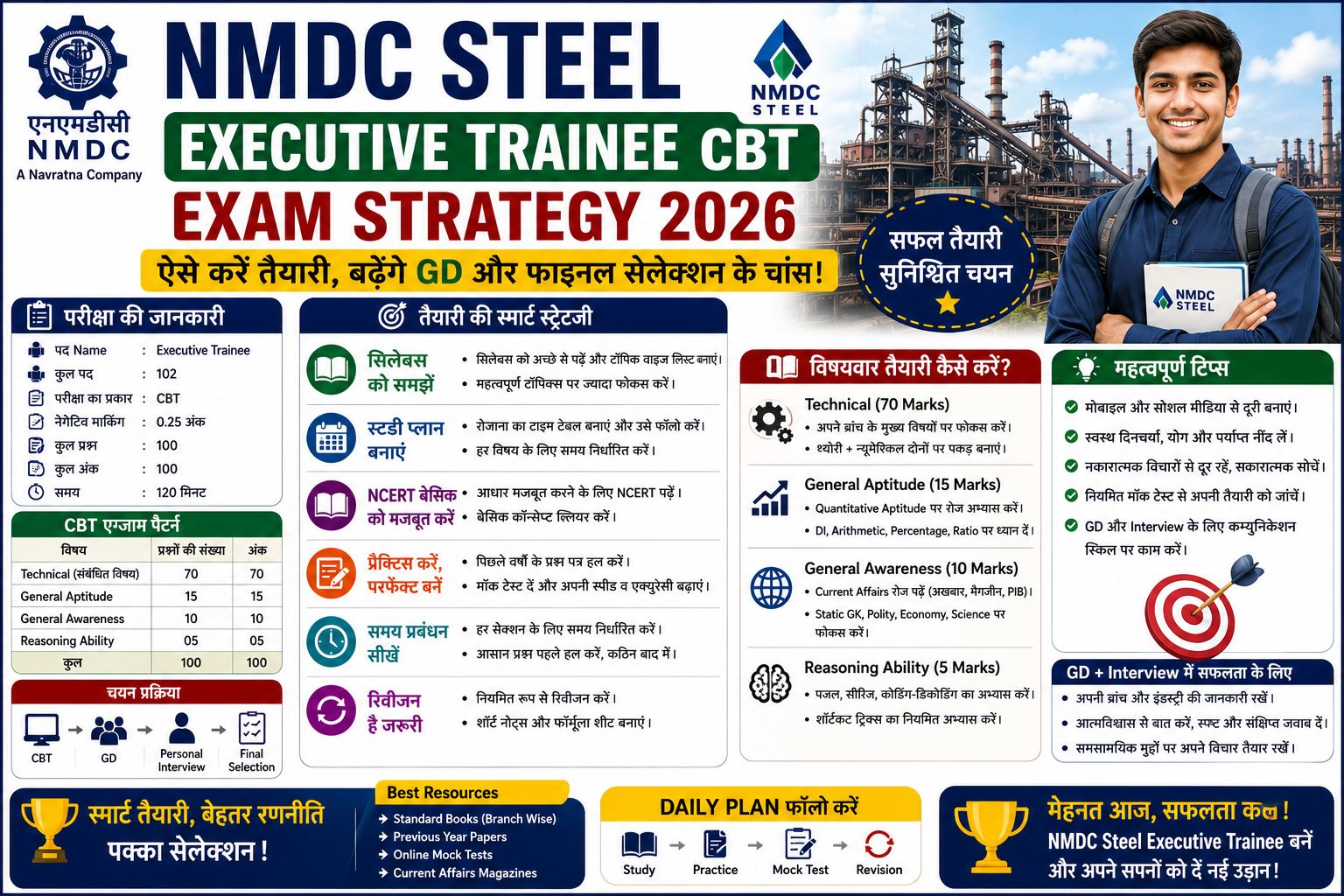
अगर आपने NMDC Steel Limited Executive Trainee Recruitment 2026 के लिए आवेदन किया है, तो अब सबसे महत्वपूर्ण चरण Computer-Based Test (CBT) की तैयारी है। इस परीक्षा का महत्व इसलिए भी अधिक है क्योंकि अंतिम चयन में CBT के अंक 70% वेटेज रखते हैं। केवल वही उम्मीदवार अगले चरण यानी Group Discussion (GD) और Interview के लिए बुलाए जाएंगे, जो न्यूनतम क्वालिफाइंग अंक प्राप्त करने के साथ-साथ अपनी ब्रांच और कैटेगरी में बेहतर रैंक हासिल करेंगे।
ध्यान देने वाली बात यह है कि आधिकारिक नोटिफिकेशन में अभी विस्तृत सिलेबस, प्रश्नों की संख्या, परीक्षा अवधि और मार्किंग स्कीम जारी नहीं की गई है। इसलिए उम्मीदवारों को समान PSU भर्तियों के आधार पर स्मार्ट तैयारी करनी चाहिए।
इस लेख में हम NMDC Steel Executive Trainee CBT Exam Strategy 2026, संभावित परीक्षा पैटर्न, विषयवार तैयारी, अध्ययन योजना, महत्वपूर्ण किताबें और परीक्षा के दिन की रणनीति के बारे में विस्तार से जानेंगे।
NMDC Steel Executive Trainee CBT 2026 Overview
| विवरण | जानकारी |
|---|---|
| परीक्षा | Computer Based Test (CBT) |
| प्रश्नों का प्रकार | Objective Multiple Choice Questions (MCQs) |
| भाषा | हिन्दी एवं अंग्रेज़ी |
| अंतिम चयन में वेटेज | 70% |
| परीक्षा का आधार | संबंधित शाखा (Discipline) |
| अगले चरण | Group Discussion (15%) + Interview (15%) |
आधिकारिक नोटिफिकेशन में क्या जानकारी दी गई है?
NMDC Steel Limited द्वारा जारी नोटिफिकेशन के अनुसार CBT परीक्षा से जुड़ी निम्न जानकारी उपलब्ध है—
- परीक्षा Objective Multiple Choice Questions (MCQs) पर आधारित होगी।
- प्रश्न पत्र हिन्दी और अंग्रेज़ी दोनों भाषाओं में उपलब्ध रहेगा।
- प्रश्न संबंधित डिसिप्लिन (Technical Subject) से होंगे।
- CBT के आधार पर उम्मीदवारों को GD और Interview के लिए शॉर्टलिस्ट किया जाएगा।
CBT Qualifying Marks
| श्रेणी | न्यूनतम अंक |
|---|---|
| UR / EWS | 50 |
| OBC-NCL | 45 |
| SC / ST / PwBD | 40 |
महत्वपूर्ण: केवल न्यूनतम अंक लाना पर्याप्त नहीं होगा। GD और Interview के लिए प्रत्येक शाखा एवं श्रेणी में 1:3 के अनुपात में सबसे बेहतर प्रदर्शन करने वाले उम्मीदवारों को ही बुलाया जाएगा।
अभी कौन-सी जानकारी जारी नहीं हुई है?
आधिकारिक नोटिफिकेशन में अभी निम्न विवरण उपलब्ध नहीं हैं—
- कुल प्रश्नों की संख्या
- परीक्षा की अवधि
- मार्किंग स्कीम
- नेगेटिव मार्किंग की जानकारी
- विस्तृत सिलेबस
उम्मीदवारों को सलाह दी जाती है कि वे NMDC Steel Limited के Careers Page पर नियमित रूप से विजिट करें ताकि सिलेबस, परीक्षा पैटर्न, एडमिट कार्ड और Mock Test से जुड़ी नई जानकारी समय पर मिल सके।
संभावित CBT Exam Pattern 2026
पिछली NMDC, SAIL और अन्य PSU Executive/Management Trainee परीक्षाओं के आधार पर संभावित परीक्षा पैटर्न कुछ इस प्रकार हो सकता है।
| सेक्शन | संभावित वेटेज | तैयारी की प्राथमिकता |
|---|---|---|
| Technical / Domain Knowledge | 50–70% | सबसे अधिक |
| Quantitative Aptitude | 10–15% | मध्यम |
| Reasoning Ability | 10–15% | मध्यम |
| English Language | 5–10% | आसान से मध्यम |
| General Awareness / Current Affairs | 5–10% | मध्यम |
तैयारी करते समय यह मानकर चलें कि Technical Subject ही चयन में सबसे बड़ा अंतर पैदा करेगा। यदि बाद में परीक्षा में Aptitude भी शामिल हो, तो उसकी तैयारी भी आपके लिए फायदेमंद रहेगी।
तैयारी की सही प्राथमिकता
CBT की तैयारी करते समय निम्न क्रम अपनाना सबसे उपयोगी रहेगा—
- सबसे पहले अपने Technical Subject को मजबूत करें।
- इसके बाद Quantitative Aptitude और Reasoning पर काम करें।
- फिर English और Current Affairs की तैयारी करें।
- नियमित रूप से Full-Length Mock Test दें।
- हर Mock के बाद अपनी गलतियों का विश्लेषण करें और उन्हें दोहराने से बचें।
Discipline-wise Technical Preparation
Mechanical Engineering
इस भर्ती में Mechanical के 51 पद हैं, इसलिए प्रतियोगिता सबसे अधिक रहने की संभावना है।
मुख्य विषय—
- Thermodynamics
- Strength of Materials
- Theory of Machines
- Fluid Mechanics
- Heat Transfer
- Manufacturing Technology
- Machine Design
- Industrial Engineering
- Engineering Mechanics
Electrical Engineering
महत्वपूर्ण विषय—
- Electrical Machines
- Power Systems
- Power Electronics
- Control Systems
- Network Theory
- Electrical Circuits
- Utilization of Electrical Energy
- Basic Electronics
Civil Engineering
फोकस करें—
- Strength of Materials
- Structural Analysis
- RCC Design
- Steel Design
- Building Materials
- Surveying
- Fluid Mechanics
- Hydraulics
- Environmental Engineering
- Geotechnical Engineering
- Estimation & Costing
Chemical Engineering
महत्वपूर्ण टॉपिक—
- Chemical Reaction Engineering
- Mass Transfer
- Heat Transfer
- Fluid Mechanics
- Process Calculations
- Thermodynamics
- Mechanical Operations
- Process Control
Metallurgy
तैयारी करें—
- Physical Metallurgy
- Mechanical Metallurgy
- Extractive Metallurgy
- Iron & Steel Making
- Phase Diagrams
- Heat Treatment
- Material Testing
Instrumentation
मुख्य विषय—
- Sensors & Transducers
- Process Control
- Industrial Instrumentation
- Control Systems
- Electronics
- Measurement Systems
Computer & IT
इन विषयों पर विशेष ध्यान दें—
- Data Structures
- Algorithms
- Operating Systems
- DBMS
- Computer Networks
- Software Engineering
- Programming Concepts (C, C++, Java, Python की मूल बातें)
Finance
महत्वपूर्ण विषय—
- Financial Accounting
- Cost Accounting
- Financial Management
- Taxation
- Auditing
- Corporate Finance
- Working Capital Management
- Ratio Analysis
Human Resources (HR)
मुख्य टॉपिक—
- Human Resource Management
- Industrial Relations
- Labour Laws
- Organisational Behaviour
- Recruitment & Selection
- Performance Management
- Training & Development
- Compensation Management
60–75 दिनों की Smart Study Plan
यदि परीक्षा सितंबर–अक्टूबर 2026 में होती है, तो तैयारी को तीन चरणों में बांटा जा सकता है।
Phase 1 (पहले 25–30 दिन)
- Core Technical Subjects पूरे करें।
- हर सप्ताह 1–2 विषय समाप्त करें।
- Short Notes और Formula Sheets तैयार करें।
- रोजाना 1 घंटा Quant और Reasoning पढ़ें।
Phase 2 (अगले 20–25 दिन)
- सभी Technical Topics पूरे करें।
- पिछले वर्षों के प्रश्न हल करें।
- Engineering उम्मीदवार GATE के प्रश्नों का अभ्यास करें।
- Finance उम्मीदवार CA/CS Foundation स्तर के प्रश्न हल करें।
- Sectional Mock Tests देना शुरू करें।
Phase 3 (अंतिम 15–20 दिन)
- 8 से 12 Full-Length Mock Tests दें।
- Time Management और Accuracy पर विशेष ध्यान दें।
- केवल Short Notes और कमजोर विषयों का Revision करें।
- पिछले 6–8 महीनों के Current Affairs दोहराएं।
- विशेष रूप से Steel Sector, Economy और National News पर फोकस करें।
रोजाना पढ़ाई का सुझाव
एक संतुलित अध्ययन योजना कुछ इस प्रकार हो सकती है—
| विषय | समय |
|---|---|
| Technical Concepts + Practice | 4–5 घंटे |
| Quantitative Aptitude + Reasoning | 1–1.5 घंटे |
| English + General Awareness | 45–60 मिनट |
| Revision + Formula Revision | 30–45 मिनट |
तैयारी के लिए उपयोगी पुस्तकें और संसाधन
Technical Subjects
- Standard Engineering Textbooks
- Made Easy Notes
- ACE Academy Notes
- IES Master Study Material
- GATE Notes
Quantitative Aptitude एवं Reasoning
- RS Aggarwal
- बैंकिंग एवं PSU परीक्षा की अच्छी तैयारी पुस्तकें
- पिछले वर्षों के PSU प्रश्नपत्र
English
- Wren & Martin (चयनित अध्याय)
- Error Spotting
- Vocabulary
- Previous Year Questions
Mock Test
- Testbook
- Oliveboard
- Adda247
- PSU Specific Test Series
Previous Year Papers
- NMDC Junior Officer
- SAIL Management Trainee
- अन्य Steel PSU भर्ती परीक्षाएं
परीक्षा के दिन अपनाएं ये रणनीति
CBT के दौरान कुछ छोटी बातें आपका स्कोर काफी बढ़ा सकती हैं।
- पहले आसान प्रश्न हल करें।
- किसी एक प्रश्न पर 1–1.5 मिनट से अधिक समय न दें।
- Accuracy बनाए रखें क्योंकि मेरिट रैंक सबसे महत्वपूर्ण होगी।
- यदि नेगेटिव मार्किंग नहीं होती है (जैसा कि कई NMDC परीक्षाओं में देखा गया है), तो सोच-समझकर अधिकतम प्रश्नों का प्रयास करें।
- अंत में 10–15 मिनट उत्तरों की समीक्षा के लिए रखें।
CBT के बाद क्या करें?
कई उम्मीदवार CBT के बाद परिणाम का इंतजार करते हैं, जबकि यह सही रणनीति नहीं है।
CBT समाप्त होने के तुरंत बाद—
- Group Discussion की तैयारी शुरू करें।
- Interview के लिए अपने Technical Subject का Revision करें।
- Steel Industry और NMDC Steel Limited के बारे में जानकारी जुटाएं।
- Current Affairs और व्यक्तित्व विकास पर भी ध्यान दें।
GD में तकनीकी और सामान्य दोनों प्रकार के विषय पूछे जा सकते हैं, जबकि Interview में आपके विषय ज्ञान, Steel Plant से जुड़ी समझ और व्यक्तित्व का मूल्यांकन किया जाएगा।
अंतिम सलाह
NMDC Steel Executive Trainee Recruitment 2026 में Mechanical और Electrical शाखाओं में सबसे अधिक प्रतिस्पर्धा रहने की संभावना है। ऐसे में केवल क्वालिफाइंग अंक प्राप्त करना पर्याप्त नहीं होगा। आपको अपनी शाखा और श्रेणी में बेहतर रैंक हासिल करनी होगी।
यदि आप Technical Subject पर मजबूत पकड़, नियमित Mock Test Practice, समय-समय पर गलतियों का विश्लेषण और अनुशासित अध्ययन योजना अपनाते हैं, तो GD और Interview तक पहुंचने की संभावना काफी बढ़ जाएगी।
FAQs
Q1. NMDC Steel Executive Trainee CBT का अंतिम चयन में कितना वेटेज है?
उत्तर: CBT का अंतिम चयन में 70% वेटेज है। यह भर्ती प्रक्रिया का सबसे महत्वपूर्ण चरण है।
Q2. CBT में प्रश्न किस प्रकार के होंगे?
उत्तर: परीक्षा में Objective Multiple Choice Questions (MCQs) होंगे और प्रश्न पत्र हिन्दी एवं अंग्रेज़ी दोनों भाषाओं में उपलब्ध रहेगा।
Q3. CBT के बाद उम्मीदवारों का चयन कैसे होगा?
उत्तर: CBT के अंकों के आधार पर प्रत्येक शाखा और श्रेणी में 1:3 के अनुपात में उम्मीदवारों को Group Discussion और Interview के लिए बुलाया जाएगा।
Q4. CBT के लिए न्यूनतम क्वालिफाइंग अंक कितने हैं?
उत्तर: UR/EWS के लिए 50, OBC-NCL के लिए 45 तथा SC/ST/PwBD उम्मीदवारों के लिए 40 अंक निर्धारित किए गए हैं।
Q5. क्या आधिकारिक सिलेबस और परीक्षा पैटर्न जारी हो गए हैं?
उत्तर: नहीं। अभी केवल CBT की मूल जानकारी जारी की गई है। प्रश्नों की संख्या, परीक्षा अवधि, विस्तृत सिलेबस और मार्किंग स्कीम जारी होना बाकी है। उम्मीदवारों को नियमित रूप से NMDC Steel Limited के आधिकारिक Careers Page पर नवीनतम अपडेट देखते रहना चाहिए।
NMDC Steel Executive Trainee CBT 2026 Important MCQs
Mechanical Engineering
Q1. Which thermodynamic process has constant entropy?
A) Isothermal
B) Isobaric
C) Isochoric
D) Isentropic
✅ Answer: D) Isentropic
Q2. Which cycle is used in modern steam power plants?
A) Otto Cycle
B) Diesel Cycle
C) Rankine Cycle
D) Brayton Cycle
✅ Answer: C) Rankine Cycle
Q3. According to Hooke’s Law, stress is proportional to:
A) Temperature
B) Strain
C) Pressure
D) Density
✅ Answer: B) Strain
Q4. Which bearing mainly supports radial load?
A) Thrust Bearing
B) Journal Bearing
C) Footstep Bearing
D) Collar Bearing
✅ Answer: B) Journal Bearing
Q5. The SI unit of Power is:
A) Joule
B) Watt
C) Pascal
D) Newton
✅ Answer: B) Watt
Q6. Which machining process produces internal threads?
A) Drilling
B) Tapping
C) Reaming
D) Milling
✅ Answer: B) Tapping
Q7. Which material is commonly used for cutting tools?
A) Brass
B) HSS
C) Copper
D) Aluminium
✅ Answer: B) HSS
Q8. Heat transfer by electromagnetic waves is called:
A) Conduction
B) Convection
C) Radiation
D) Diffusion
✅ Answer: C) Radiation
Electrical Engineering
Q9. Transformer works on the principle of:
A) Electrostatic Induction
B) Electromagnetic Induction
C) Magnetic Saturation
D) Rectification
✅ Answer: B) Electromagnetic Induction
Q10. SI unit of capacitance is:
A) Henry
B) Ohm
C) Farad
D) Weber
✅ Answer: C) Farad
Q11. Which motor is suitable for electric traction?
A) Induction Motor
B) DC Series Motor
C) Synchronous Motor
D) Universal Motor
✅ Answer: B) DC Series Motor
Q12. Frequency of AC supply in India is:
A) 60 Hz
B) 40 Hz
C) 25 Hz
D) 50 Hz
✅ Answer: D) 50 Hz
Q13. Power factor of a purely resistive circuit is:
A) 0
B) 0.5
C) 1
D) 0.8
✅ Answer: C) 1
Q14. Which device converts AC to DC?
A) Rectifier
B) Inverter
C) Chopper
D) Oscillator
✅ Answer: A) Rectifier
Q15. Kirchhoff’s Current Law is based on:
A) Conservation of Energy
B) Conservation of Charge
C) Ohm’s Law
D) Faraday’s Law
✅ Answer: B) Conservation of Charge
Q16. The unit of electrical resistance is:
A) Volt
B) Ohm
C) Watt
D) Ampere
✅ Answer: B) Ohm
Civil Engineering
Q17. Initial setting time of Ordinary Portland Cement should not be less than:
A) 10 min
B) 20 min
C) 30 min
D) 60 min
✅ Answer: C) 30 min
Q18. Slump Test measures:
A) Strength
B) Workability
C) Density
D) Durability
✅ Answer: B) Workability
Q19. Theodolite is used for:
A) Levelling
B) Measuring Angles
C) Soil Testing
D) Concrete Mixing
✅ Answer: B) Measuring Angles
Q20. Which type of foundation is suitable for weak soil?
A) Strip Foundation
B) Raft Foundation
C) Isolated Footing
D) Wall Footing
✅ Answer: B) Raft Foundation
Chemical Engineering (Q21–Q23)
Q21. Reynolds Number indicates:
A) Heat Transfer
B) Fluid Flow Regime
C) Pressure
D) Density
✅ Answer: B) Fluid Flow Regime
Q22. Distillation is based on difference in:
A) Density
B) Viscosity
C) Boiling Point
D) Surface Tension
✅ Answer: C) Boiling Point
Q23. SI unit of viscosity is:
A) Pascal-second
B) Newton
C) Joule
D) Watt
✅ Answer: A) Pascal-second
Metallurgy (Q24–Q25)
Q24. Pig Iron contains approximately:
A) 0.2% Carbon
B) 1% Carbon
C) 3–4% Carbon
D) 7% Carbon
✅ Answer: C) 3–4% Carbon
Q25. Which heat treatment improves hardness?
A) Annealing
B) Tempering
C) Normalizing
D) Hardening
✅ Answer: D) Hardening
Instrumentation Engineering
Q26. Which sensor is commonly used for temperature measurement?
A) LVDT
B) Thermocouple
C) Strain Gauge
D) Tachometer
✅ Answer: B) Thermocouple
Q27. LVDT is mainly used to measure:
A) Pressure
B) Temperature
C) Linear Displacement
D) Speed
✅ Answer: C) Linear Displacement
Q28. Which instrument measures pressure?
A) Tachometer
B) Manometer
C) Hygrometer
D) Lux Meter
✅ Answer: B) Manometer
Q29. RTD generally uses which material?
A) Copper
B) Platinum
C) Iron
D) Aluminium
✅ Answer: B) Platinum
Q30. The unit of pressure is:
A) Joule
B) Pascal
C) Watt
D) Volt
✅ Answer: B) Pascal
Q31. Which device converts a physical quantity into an electrical signal?
A) Relay
B) Actuator
C) Transducer
D) Amplifier
✅ Answer: C) Transducer
Q32. A strain gauge is used to measure:
A) Temperature
B) Pressure
C) Strain
D) Humidity
✅ Answer: C) Strain
Q33. PID Controller stands for:
A) Pressure Integrated Device
B) Proportional Integral Derivative
C) Process Input Detector
D) Pulse Integrated Drive
✅ Answer: B) Proportional Integral Derivative
Q34. Which instrument measures rotational speed?
A) Ammeter
B) Barometer
C) Tachometer
D) Voltmeter
✅ Answer: C) Tachometer
Q35. Which instrument measures humidity?
A) Hygrometer
B) Anemometer
C) Barometer
D) Thermometer
✅ Answer: A) Hygrometer
Q36. In a control system, feedback is used to:
A) Increase error
B) Reduce system accuracy
C) Improve stability and accuracy
D) Increase power consumption
✅ Answer: C) Improve stability and accuracy
Q37. Which signal is continuous in both time and amplitude?
A) Digital Signal
B) Analog Signal
C) Binary Signal
D) Pulse Signal
✅ Answer: B) Analog Signal
Q38. Which controller completely eliminates steady-state error in many control systems?
A) P Controller
B) PD Controller
C) PI Controller
D) ON-OFF Controller
✅ Answer: C) PI Controller
Computer & IT
Q39. Which data structure follows the FIFO principle?
A) Stack
B) Queue
C) Tree
D) Graph
✅ Answer: B) Queue
Q40. Which data structure follows the LIFO principle?
A) Queue
B) Stack
C) Linked List
D) Heap
✅ Answer: B) Stack
Q41. Which sorting algorithm generally has the best average-case complexity?
A) Bubble Sort
B) Selection Sort
C) Quick Sort
D) Insertion Sort
✅ Answer: C) Quick Sort
Q42. Which protocol is primarily used for secure web browsing?
A) HTTP
B) FTP
C) HTTPS
D) SMTP
✅ Answer: C) HTTPS
Q43. SQL is mainly used for:
A) Designing Networks
B) Database Management
C) Programming Games
D) Image Processing
✅ Answer: B) Database Management
Q44. Which normal form removes transitive dependency?
A) First Normal Form (1NF)
B) Second Normal Form (2NF)
C) Third Normal Form (3NF)
D) Boyce-Codd Normal Form (BCNF)
✅ Answer: C) Third Normal Form (3NF)
Q45. Which OSI layer is responsible for routing?
A) Physical Layer
B) Data Link Layer
C) Network Layer
D) Session Layer
✅ Answer: C) Network Layer
Q46. Which of the following is not an Operating System?
A) Linux
B) Windows
C) Oracle
D) macOS
✅ Answer: C) Oracle
Q47. Which memory is volatile?
A) ROM
B) Hard Disk
C) RAM
D) SSD
✅ Answer: C) RAM
Q48. Which database language is used to retrieve data?
A) DDL
B) DML
C) DCL
D) TCL
✅ Answer: B) DML
Q49. Which protocol is commonly used to send emails?
A) HTTP
B) SMTP
C) FTP
D) DNS
✅ Answer: B) SMTP
Q50. Which of the following has the time complexity O(log n) in the average case?
A) Linear Search
B) Binary Search
C) Bubble Sort
D) Selection Sort
✅ Answer: B) Binary Search
Financial Accounting
Q51. Which accounting concept assumes that a business will continue its operations indefinitely?
A) Matching Concept
B) Going Concern Concept
C) Money Measurement Concept
D) Dual Aspect Concept
✅ Answer: B) Going Concern Concept
Q52. Which financial statement shows the financial position of a company on a specific date?
A) Trading Account
B) Profit & Loss Account
C) Balance Sheet
D) Cash Book
✅ Answer: C) Balance Sheet
Q53. Depreciation is charged to:
A) Increase asset value
B) Reduce profit
C) Increase liabilities
D) Increase owner’s capital
✅ Answer: B) Reduce profit
Q54. Which accounting principle requires expenses to be matched with the revenue earned?
A) Prudence Concept
B) Matching Principle
C) Consistency Principle
D) Business Entity Concept
✅ Answer: B) Matching Principle
Q55. Which account is classified as a Current Asset?
A) Building
B) Machinery
C) Cash in Hand
D) Furniture
✅ Answer: C) Cash in Hand
Q56. Which of the following is an intangible asset?
A) Building
B) Machinery
C) Goodwill
D) Land
✅ Answer: C) Goodwill
Q57. Which accounting standard governs the Cash Flow Statement in India?
A) AS-2
B) AS-3
C) AS-10
D) AS-26
✅ Answer: B) AS-3
Q58. Which journal entry is passed for depreciation?
A) Cash A/c Dr.
B) Depreciation A/c Dr.
To Asset A/c
C) Asset A/c Dr.
D) Sales A/c Dr.
✅ Answer: B) Depreciation A/c Dr. To Asset A/c
Cost Accounting
Q59. Prime Cost is equal to:
A) Direct Material + Direct Labour
B) Factory Cost + Administration Cost
C) Selling Cost + Distribution Cost
D) Total Cost – Profit
✅ Answer: A) Direct Material + Direct Labour
Q60. Which cost remains constant irrespective of production level?
A) Variable Cost
B) Fixed Cost
C) Semi-variable Cost
D) Marginal Cost
✅ Answer: B) Fixed Cost
Q61. Which costing method is suitable for steel plants?
A) Job Costing
B) Batch Costing
C) Process Costing
D) Contract Costing
✅ Answer: C) Process Costing
Q62. Contribution is calculated as:
A) Sales − Variable Cost
B) Sales − Fixed Cost
C) Profit − Fixed Cost
D) Total Cost − Sales
✅ Answer: A) Sales − Variable Cost
Q63. Break-even Point occurs when:
A) Profit is maximum
B) Sales equal Variable Cost
C) Total Revenue equals Total Cost
D) Contribution is zero
✅ Answer: C) Total Revenue equals Total Cost
Q64. Which inventory valuation method generally results in lower closing inventory during rising prices?
A) FIFO
B) LIFO
C) Weighted Average
D) Standard Cost
✅ Answer: B) LIFO
Financial Management
Q65. Working Capital is calculated as:
A) Total Assets − Fixed Assets
B) Current Assets − Current Liabilities
C) Total Liabilities − Equity
D) Fixed Assets − Current Liabilities
✅ Answer: B) Current Assets − Current Liabilities
Q66. Which ratio measures short-term liquidity?
A) Debt-Equity Ratio
B) Current Ratio
C) Return on Equity
D) Net Profit Ratio
✅ Answer: B) Current Ratio
Q67. Which financial decision relates to raising long-term funds?
A) Dividend Decision
B) Financing Decision
C) Working Capital Decision
D) Inventory Decision
✅ Answer: B) Financing Decision
Q68. Net Present Value (NPV) is mainly used for:
A) Budgeting
B) Capital Budgeting
C) Inventory Management
D) Cost Accounting
✅ Answer: B) Capital Budgeting
Q69. Which source of finance does not create repayment liability?
A) Bank Loan
B) Debenture
C) Equity Share Capital
D) Term Loan
✅ Answer: C) Equity Share Capital
Q70. Internal Rate of Return (IRR) is the discount rate at which:
A) Profit becomes zero
B) NPV becomes zero
C) Sales become zero
D) Fixed Cost becomes zero
✅ Answer: B) NPV becomes zero
Taxation & Auditing
Q71. GST stands for:
A) General Sales Tax
B) Goods and Services Tax
C) Government Service Tax
D) Global Sales Tax
✅ Answer: B) Goods and Services Tax
Q72. Which audit is mandatory for companies under the Companies Act?
A) Internal Audit
B) Cost Audit
C) Statutory Audit
D) Tax Audit
✅ Answer: C) Statutory Audit
Q73. The primary objective of an audit is to:
A) Detect all frauds
B) Prepare financial statements
C) Express an opinion on the financial statements
D) Calculate income tax
✅ Answer: C) Express an opinion on the financial statements
Q74. Which tax is levied on company profits?
A) Property Tax
B) Corporate Tax
C) Excise Duty
D) Stamp Duty
✅ Answer: B) Corporate Tax
Q75. Which financial ratio measures profitability from shareholders’ perspective?
A) Current Ratio
B) Debt-Equity Ratio
C) Return on Equity (ROE)
D) Inventory Turnover Ratio
✅ Answer: C) Return on Equity (ROE)
Human Resources
Q76. Human Resource Management (HRM) primarily deals with:
A) Managing machines
B) Managing financial assets
C) Managing human resources in an organization
D) Managing production only
✅ Answer: C) Managing human resources in an organization
Q77. Which of the following is the first step in the recruitment process?
A) Interview
B) Selection
C) Manpower Planning
D) Training
✅ Answer: C) Manpower Planning
Q78. Which recruitment source involves hiring employees from within the organization?
A) Campus Recruitment
B) Internal Recruitment
C) Employment Exchange
D) Newspaper Advertisement
✅ Answer: B) Internal Recruitment
Q79. Performance Appraisal is mainly used to:
A) Reduce salaries
B) Evaluate employee performance
C) Recruit employees
D) Prepare company budget
✅ Answer: B) Evaluate employee performance
Q80. Which leadership style involves employees in decision-making?
A) Autocratic
B) Democratic
C) Bureaucratic
D) Laissez-faire
✅ Answer: B) Democratic
Q81. Which theory was proposed by Abraham Maslow?
A) Two-Factor Theory
B) Scientific Management
C) Hierarchy of Needs
D) Equity Theory
✅ Answer: C) Hierarchy of Needs
Q82. Herzberg’s Two-Factor Theory divides factors into:
A) Internal & External
B) Financial & Non-Financial
C) Hygiene & Motivational Factors
D) Fixed & Variable Factors
✅ Answer: C) Hygiene & Motivational Factors
Q83. Which Act primarily governs industrial disputes in India?
A) Factories Act
B) Industrial Disputes Act
C) Minimum Wages Act
D) Employees’ State Insurance Act
✅ Answer: B) Industrial Disputes Act
Q84. Collective Bargaining refers to:
A) Negotiation between employer and employees
B) Salary calculation
C) Employee promotion
D) Performance appraisal
✅ Answer: A) Negotiation between employer and employees
Q85. Which method is commonly used for employee training?
A) Job Rotation
B) Transfer
C) Suspension
D) Demotion
✅ Answer: A) Job Rotation
Q86. Which of the following is a financial incentive?
A) Promotion
B) Recognition
C) Bonus
D) Appreciation Letter
✅ Answer: C) Bonus
Q87. SWOT Analysis stands for:
A) Strengths, Weaknesses, Opportunities, Threats
B) Skills, Work, Output, Target
C) System, Work, Operations, Technology
D) Staff, Welfare, Organization, Training
✅ Answer: A) Strengths, Weaknesses, Opportunities, Threats
Q88. Which function of HR focuses on employee welfare and engagement?
A) Recruitment
B) Industrial Relations
C) Employee Relations
D) Payroll Processing
✅ Answer: C) Employee Relations
Q89. Attrition Rate refers to:
A) Employee salary
B) Employee turnover
C) Employee attendance
D) Employee promotion
✅ Answer: B) Employee turnover
Q90. Which HR activity identifies future training needs?
A) Job Analysis
B) Training Need Analysis (TNA)
C) Recruitment Planning
D) Payroll Audit
✅ Answer: B) Training Need Analysis (TNA)
Mixed Revision MCQs
Q91. Which steel-making process uses a Basic Oxygen Furnace?
A) Bessemer Process
B) BOF Process
C) Cupola Furnace
D) Open Hearth Furnace
✅ Answer: B) BOF Process
Q92. Which organization is known as the “Steel Authority of India”?
A) NTPC
B) SAIL
C) ONGC
D) BHEL
✅ Answer: B) SAIL
Q93. Which gas is primarily used in steel plants for cutting operations?
A) Nitrogen
B) Oxygen
C) Helium
D) Argon
✅ Answer: B) Oxygen
Q94. Which constitutional body conducts recruitment for Central Government Group ‘A’ services?
A) RBI
B) UPSC
C) SSC
D) NITI Aayog
✅ Answer: B) UPSC
Q95. Which Fundamental Right is guaranteed under Article 14 of the Constitution of India?
A) Freedom of Religion
B) Right to Equality
C) Right to Education
D) Freedom of Speech
✅ Answer: B) Right to Equality
Q96. Which organization regulates monetary policy in India?
A) SEBI
B) NABARD
C) RBI
D) SIDBI
✅ Answer: C) RBI
Q97. Which index measures inflation based on wholesale prices?
A) CPI
B) WPI
C) IIP
D) GDP Deflator
✅ Answer: B) WPI
Q98. Which ministry is responsible for NMDC Steel Limited?
A) Ministry of Heavy Industries
B) Ministry of Steel
C) Ministry of Commerce
D) Ministry of Mines
✅ Answer: B) Ministry of Steel
Q99. Which company operates the Nagarnar Steel Plant?
A) SAIL
B) RINL
C) NMDC Steel Limited
D) Tata Steel
✅ Answer: C) NMDC Steel Limited
Q100. In the NMDC Steel Executive Trainee Recruitment 2026, the final selection weightage is:
A) CBT 50% + GD 25% + Interview 25%
B) CBT 60% + Interview 40%
C) CBT 70% + GD 15% + Interview 15%
D) CBT 80% + Interview 20%
✅ Answer: C) CBT 70% + GD 15% + Interview 15%

Leave a Comment