
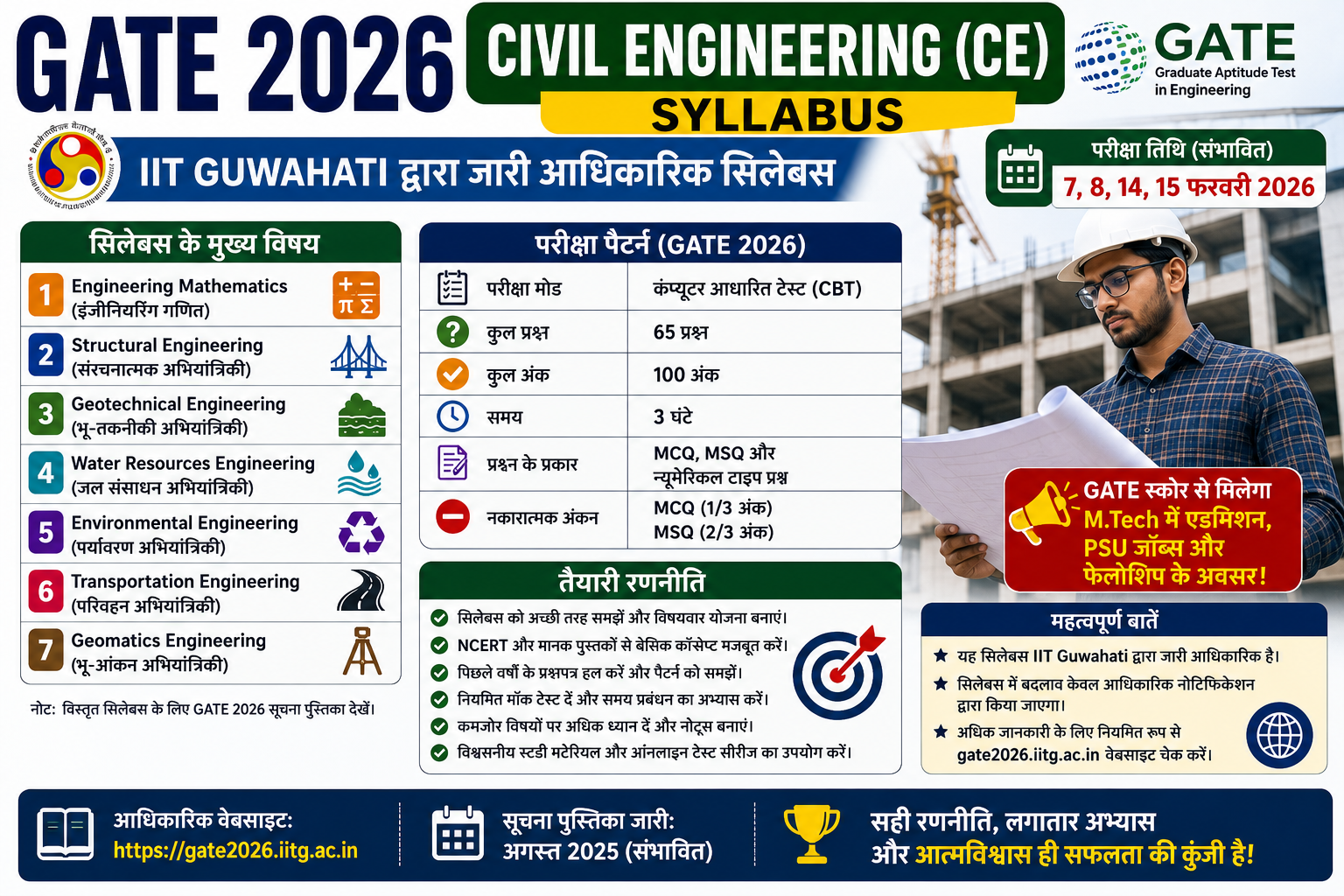
अगर आप GATE Civil Engineering (CE) 2026 की तैयारी कर रहे हैं या ULB Haryana Engineering Associate (Civil) Recruitment 2026 के लिए आवेदन कर चुके हैं, तो आपके लिए आधिकारिक सिलेबस की जानकारी होना बेहद जरूरी है। IIT Guwahati, जो GATE 2026 का आयोजन संस्थान है, ने Civil Engineering (CE) का आधिकारिक सिलेबस जारी कर दिया है। इस वर्ष सिलेबस में पिछले वर्षों की तुलना में कोई बड़ा बदलाव नहीं किया गया है।
GATE परीक्षा में General Aptitude, Engineering Mathematics और Civil Engineering के मुख्य विषय शामिल हैं। ULB Haryana Engineering Associate (Civil) भर्ती में भी चयन पिछले दो वर्षों के वैध GATE Score के आधार पर किया जाएगा। ऐसे में उम्मीदवारों को GATE के आधिकारिक सिलेबस के अनुसार ही तैयारी करनी चाहिए।
इस लेख में आपको GATE Civil Engineering Syllabus 2026, परीक्षा पैटर्न, विषयवार सिलेबस, महत्वपूर्ण टॉपिक्स और तैयारी की रणनीति विस्तार से मिलेगी।
GATE Civil Engineering 2026 Highlights
| विवरण | जानकारी |
|---|---|
| परीक्षा | GATE 2026 |
| पेपर | Civil Engineering (CE) |
| आयोजन संस्थान | IIT Guwahati |
| कुल अंक | 100 |
| कुल प्रश्न | 65 |
| परीक्षा अवधि | 3 घंटे |
| General Aptitude | 15 अंक |
| Engineering Mathematics + Civil Engineering | 85 अंक |
GATE Civil Engineering Exam Pattern 2026
GATE Civil Engineering पेपर तीन भागों में विभाजित होता है।
| सेक्शन | अंक |
|---|---|
| General Aptitude | 15 |
| Engineering Mathematics | 13–15 (85 अंकों का हिस्सा) |
| Civil Engineering Subjects | शेष अंक |
| कुल | 100 |
परीक्षा में कुल 65 प्रश्न पूछे जाते हैं और परीक्षा की अवधि 3 घंटे होती है।
GATE Civil Engineering Syllabus 2026
आधिकारिक सिलेबस को सात मुख्य तकनीकी सेक्शन तथा एक General Aptitude सेक्शन में विभाजित किया गया है।
Section 1 – Engineering Mathematics
Engineering Mathematics लगभग हर वर्ष अच्छा वेटेज रखता है। इस भाग में निम्न विषय शामिल हैं।
Linear Algebra
- Matrix Algebra
- System of Linear Equations
- Eigenvalues
- Eigenvectors
Calculus
- Single Variable Functions
- Limits
- Continuity
- Differentiability
- Mean Value Theorem
- Local Maxima एवं Minima
- Taylor Series
- Definite एवं Indefinite Integrals
- Area एवं Volume
- Partial Derivatives
- Total Derivatives
- Gradient
- Divergence
- Curl
- Vector Identities
- Directional Derivatives
- Line Integrals
- Surface Integrals
- Volume Integrals
Ordinary Differential Equations (ODE)
- First Order Linear Equation
- Non-Linear Equation
- Higher Order Linear Equation
- Constant Coefficients
- Euler-Cauchy Equation
- Initial Value Problems
- Boundary Value Problems
Partial Differential Equations (PDE)
- Fourier Series
- Separation of Variables
- Diffusion Equation
- One-Dimensional Wave Equation
- Two-Dimensional Laplace Equation
Probability and Statistics
- Sampling Theorem
- Conditional Probability
- Mean
- Median
- Mode
- Standard Deviation
- Random Variables
- Poisson Distribution
- Normal Distribution
- Linear Regression
Numerical Methods
- Error Analysis
- Numerical Solution
- Newton Polynomial
- Lagrange Polynomial
- Numerical Differentiation
- Numerical Integration
- Trapezoidal Rule
- Simpson Rule
- Single Step Methods
- Multi Step Methods
Section 2 – Structural Engineering
यह GATE Civil का सबसे महत्वपूर्ण सेक्शन माना जाता है।
Engineering Mechanics
- Force System
- Free Body Diagram
- Equilibrium
- Internal Forces
- Friction
- Centre of Mass
- Free Vibrations
Solid Mechanics
- Bending Moment
- Shear Force
- Stress एवं Strain
- Bending Theory
- Flexural Stress
- Shear Stress
- Shear Centre
- Torsion
- Stress Transformation
- Column Buckling
- Combined Stress
Structural Analysis
- Determinate एवं Indeterminate Structures
- Force Method
- Energy Method
- Truss Analysis
- Beam Analysis
- Frame Analysis
- Cable Analysis
- Arch Analysis
- Slope Deflection Method
- Moment Distribution Method
- Influence Line
- Stiffness Method
- Flexibility Method
Construction Materials
Structural Steel
- Composition
- Material Properties
- Behaviour
Concrete
- Constituents
- Mix Design
- Short Term Properties
- Long Term Properties
Construction Management
- Types of Construction Projects
- Project Planning
- Network Analysis
- PERT
- CPM
- Cost Estimation
Concrete Structures
- Working Stress Method
- Limit State Design
- Beam Design
- Slab Design
- Column Design
- Bond
- Development Length
- Prestressed Concrete
Steel Structures
- Working Stress Method
- Limit State Design
- Tension Members
- Compression Members
- Beam
- Beam Column
- Column Base
- Connections
- Plate Girder
- Truss
- Plastic Analysis
Section 3 – Geotechnical Engineering
Soil Mechanics
- Three Phase System
- Soil Classification
- Permeability
- Seepage
- Flow Net
- Uplift Pressure
- Piping
- Capillarity
- Effective Stress
- Quicksand
- Soil Compaction
- Consolidation
- Shear Strength
- Mohr Circle
- Stress-Strain Behaviour
- Stress Path
Foundation Engineering
- Soil Investigation
- Bore Hole
- Sampling
- Plate Load Test
- SPT
- CPT
- Earth Pressure Theory
- Rankine Theory
- Coulomb Theory
- Slope Stability
- Boussinesq Theory
- Pressure Bulb
- Bearing Capacity
- Water Table Effect
- Combined Footing
- Raft Foundation
- Settlement Analysis
- Pile Foundation
- Pile Load Test
- Pile Group Efficiency
- Negative Skin Friction
Section 4 – Water Resources Engineering
Fluid Mechanics
- Fluid Properties
- Fluid Statics
- Continuity Equation
- Momentum Equation
- Energy Equation
- Potential Flow
- Laminar Flow
- Turbulent Flow
- Pipe Flow
- Boundary Layer
- Lift एवं Drag
Hydraulics
- Force on Immersed Body
- Flow Measurement
- Dimensional Analysis
- Hydraulic Similitude
- Channel Hydraulics
- Specific Energy
- Critical Flow
- Hydraulic Jump
- Uniform Flow
- Gradually Varied Flow
Hydrology
- Hydrologic Cycle
- Precipitation
- Evaporation
- Watershed
- Infiltration
- Unit Hydrograph
- Reservoir Capacity
- Flood Routing
- Surface Runoff
- Ground Water Hydrology
- Darcy Law
Irrigation
- Irrigation Systems
- Irrigation Methods
- Crop Water Requirement
- Duty
- Delta
- Evapotranspiration
- Gravity Dam
- Spillway
- Canal Design
- Weir Design
- Cross Drainage Structures
Section 5 – Environmental Engineering
Water Supply
- Water Quality
- Water Standards
- Physical Parameters
- Chemical Parameters
- Biological Parameters
- Water Quality Index
- Water Treatment
- Water Distribution System
Wastewater Engineering
- Sewerage System
- Domestic Wastewater
- Primary Treatment
- Secondary Treatment
- Effluent Standards
- Sludge Disposal
- Reuse of Treated Water
Air Pollution
- Pollutants
- Pollution Sources
- Environmental Impact
- Pollution Control
- Air Quality Standards
- Air Quality Index (AQI)
Municipal Solid Waste
- Waste Characteristics
- Waste Generation
- Collection
- Transportation
- Recycling
- Reuse
- Energy Recovery
- Waste Treatment
- Disposal
Section 6 – Transportation Engineering
Transportation Infrastructure
- Highway Geometric Design
- Cross Section Elements
- Sight Distance
- Horizontal Alignment
- Vertical Alignment
- Railway Track Design
- Speed एवं Cant
- Airport Runway
- Taxiway Design
Highway Pavements
- Highway Materials
- Material Testing
- Bituminous Mix
- Flexible Pavement
- Rigid Pavement
- IRC Codes
Traffic Engineering
- Traffic Flow
- Traffic Speed
- Peak Hour Factor
- Accident Study
- Traffic Analysis
- Microscopic Flow
- Macroscopic Flow
- Traffic Signs
- Webster Signal Design
- Highway Capacity
- Types of Intersections
Section 7 – Geomatics Engineering
- Surveying Principles
- Survey Errors
- Error Adjustment
- Maps
- Scale
- Coordinate System
- Distance Measurement
- Angle Measurement
- Levelling
- Trigonometric Levelling
- Traversing
- Triangulation
- Total Station
- Horizontal Curve
- Vertical Curve
Photogrammetry एवं Remote Sensing
- Scale
- Flying Height
- Remote Sensing Basics
- GIS Basics
General Aptitude (15 Marks)
General Aptitude सभी GATE पेपरों में समान होता है।
इसमें निम्न विषय शामिल हैं—
- Verbal Ability
- Numerical Ability
- Analytical Aptitude
- Spatial Aptitude
ULB Haryana Engineering Associate (Civil) उम्मीदवारों के लिए महत्वपूर्ण सलाह
ULB Haryana Engineering Associate (Civil) भर्ती में चयन पिछले दो वर्षों के वैध GATE Score के आधार पर किया जाएगा। इसलिए उम्मीदवारों को केवल सामान्य तैयारी तक सीमित न रहकर GATE के आधिकारिक सिलेबस पर पूरा ध्यान देना चाहिए।
बेहतर स्कोर के लिए विशेष रूप से इन विषयों पर मजबूत पकड़ बनाएं—
- Structural Engineering
- Geotechnical Engineering
- Water Resources Engineering
- Environmental Engineering
- Engineering Mathematics
- General Aptitude
साथ ही पिछले वर्षों के GATE प्रश्नपत्रों का नियमित अभ्यास करें और समय-समय पर पूरे सिलेबस का रिवीजन करते रहें।
GATE Civil Engineering Preparation Tips
- सबसे पहले आधिकारिक सिलेबस को अच्छी तरह समझें।
- प्रत्येक विषय का अलग अध्ययन कार्यक्रम बनाएं।
- Engineering Mathematics और General Aptitude को नियमित समय दें।
- पिछले वर्षों के GATE प्रश्नपत्र हल करें।
- विषयवार Mock Test देकर अपनी तैयारी का मूल्यांकन करें।
- जिन टॉपिक्स में कमजोरी हो, उन्हें बार-बार दोहराएं।
- Revision Notes तैयार करें और अंतिम दिनों में केवल उन्हीं से पढ़ाई करें।
- परीक्षा के दौरान Accuracy और Time Management पर विशेष ध्यान दें।
FAQs
Q1. GATE Civil Engineering 2026 में कुल कितने प्रश्न होंगे?
उत्तर: परीक्षा में कुल 65 प्रश्न पूछे जाएंगे।
Q2. GATE Civil Engineering परीक्षा कितने अंकों की होगी?
उत्तर: यह परीक्षा 100 अंकों की होगी।
Q3. General Aptitude का वेटेज कितना है?
उत्तर: General Aptitude के 15 अंक निर्धारित हैं।
Q4. GATE Civil Engineering का आधिकारिक सिलेबस किसने जारी किया है?
उत्तर: IIT Guwahati ने GATE 2026 का आधिकारिक Civil Engineering (CE) सिलेबस जारी किया है।
Q5. ULB Haryana Engineering Associate (Civil) भर्ती में GATE का क्या महत्व है?
उत्तर: इस भर्ती में Civil Engineering पदों के लिए चयन मुख्य रूप से पिछले दो वर्षों के वैध GATE Score के आधार पर किया जाएगा। इसलिए GATE 2025 और GATE 2026 के आधिकारिक सिलेबस के अनुसार तैयारी करना सबसे उपयुक्त रहेगा।
GATE Civil Engineering Engineering Mathematics MCQs with Answers
These important Engineering Mathematics MCQs are based on the latest GATE Civil Engineering syllabus. They are useful for GATE 2026, ULB Haryana Engineering Associate, SSC JE, RRB JE, State AE/JE, and other engineering exams.
Q1. If the determinant of a matrix is zero, then the matrix is:
A) Identity Matrix
B) Orthogonal Matrix
C) Singular Matrix
D) Diagonal Matrix
Answer: ✅ C) Singular Matrix
Explanation: A matrix with determinant equal to zero is called a singular matrix and does not have an inverse.
Q2. Which theorem guarantees that a continuous function has at least one root within an interval?
A) Taylor Theorem
B) Mean Value Theorem
C) Intermediate Value Theorem
D) Rolle’s Theorem
Answer: ✅ C) Intermediate Value Theorem
Q3. The derivative of sin(x) is:
A) cos(x)
B) -cos(x)
C) -sin(x)
D) tan(x)
Answer: ✅ A) cos(x)
Q4. The integral of 1/x is:
A) x²/2
B) ln|x| + C
C) eˣ
D) 1/x²
Answer: ✅ B) ln|x| + C
Q5. The gradient of a scalar function always points in the direction of:
A) Minimum decrease
B) Maximum increase
C) Constant value
D) Zero value
Answer: ✅ B) Maximum increase
Q6. Divergence is defined for:
A) Scalar Field
B) Vector Field
C) Matrix
D) Tensor only
Answer: ✅ B) Vector Field
Q7. Curl of a gradient is always:
A) One
B) Infinity
C) Zero
D) Undefined
Answer: ✅ C) Zero
Q8. Euler-Cauchy equation belongs to:
A) Partial Differential Equation
B) Ordinary Differential Equation
C) Algebraic Equation
D) Integral Equation
Answer: ✅ B) Ordinary Differential Equation
Q9. Fourier series is mainly used to represent:
A) Random variables
B) Periodic Functions
C) Linear equations
D) Quadratic equations
Answer: ✅ B) Periodic Functions
Q10. Which distribution is used for rare events?
A) Normal Distribution
B) Uniform Distribution
C) Poisson Distribution
D) Binomial Distribution
Answer: ✅ C) Poisson Distribution
Q11. Standard deviation measures:
A) Mean
B) Central value
C) Dispersion of data
D) Probability
Answer: ✅ C) Dispersion of data
Q12. Newton-Raphson method is used to:
A) Solve Differential Equations
B) Find Numerical Integration
C) Find Roots of Non-linear Equations
D) Matrix Inversion
Answer: ✅ C) Find Roots of Non-linear Equations
Q13. Simpson’s Rule is used for:
A) Differentiation
B) Numerical Integration
C) Probability
D) Regression
Answer: ✅ B) Numerical Integration
Q14. The eigenvalues of an identity matrix are:
A) 0
B) 1
C) n
D) -1
Answer: ✅ B) 1
Q15. If two vectors are perpendicular, their dot product is:
A) 1
B) -1
C) 0
D) Infinity
Answer: ✅ C) 0
Q16. Which numerical method uses interpolation polynomials?
A) Euler Method
B) Lagrange Method
C) Newton-Raphson
D) Gauss Elimination
Answer: ✅ B) Lagrange Method
Q17. The probability of an impossible event is:
A) 1
B) 0
C) 0.5
D) Depends on sample space
Answer: ✅ B) 0
Q18. Mean Value Theorem applies when a function is:
A) Continuous only
B) Differentiable only
C) Continuous and Differentiable
D) Constant only
Answer: ✅ C) Continuous and Differentiable
Q19. Gradient is represented by:
A) ∇
B) ∂
C) Σ
D) Δ
Answer: ✅ A) ∇ (Nabla)
Q20. Trapezoidal Rule is mainly used for:
A) Matrix multiplication
B) Numerical Integration
C) Root Finding
D) Regression Analysis
Answer: ✅ B) Numerical Integration
Engineering Mechanics MCQs
Q1. A body is said to be in equilibrium when:
A) Only the sum of horizontal forces is zero
B) Only the sum of vertical forces is zero
C) Sum of all forces and moments acting on it is zero
D) Acceleration is constant
✅ Answer: C) Sum of all forces and moments acting on it is zero.
Q2. A Free Body Diagram (FBD) is used to:
A) Calculate volume
B) Show only external loads
C) Represent all external forces and moments acting on a body
D) Find stress only
✅ Answer: C) Represent all external forces and moments acting on a body.
Q3. The SI unit of moment is:
A) N
B) N/m
C) N·m
D) Pa
✅ Answer: C) N·m
Q4. The coefficient of friction is:
A) Always greater than 1
B) Dimensionless
C) Measured in Newton
D) Equal to density
✅ Answer: B) Dimensionless
Q5. The centroid of a rectangle lies at:
A) One corner
B) Midpoint of one side
C) Geometric center
D) Top edge
✅ Answer: C) Geometric center
Solid Mechanics MCQs
Q6. Bending moment is maximum where:
A) Shear force changes sign
B) Load is zero
C) Reaction is maximum
D) Deflection is zero
✅ Answer: A) Shear force changes sign.
Q7. The unit of stress is:
A) N
B) N/m
C) N/m²
D) Joule
✅ Answer: C) N/m² (Pascal)
Q8. Young’s Modulus is the ratio of:
A) Stress to Strain
B) Strain to Stress
C) Force to Area
D) Stress to Force
✅ Answer: A) Stress to Strain
Q9. Hooke’s Law is valid up to:
A) Elastic Limit
B) Yield Point
C) Ultimate Stress
D) Breaking Point
✅ Answer: A) Elastic Limit
Q10. The shear stress is maximum in a circular shaft under:
A) Compression
B) Torsion
C) Tension
D) Bending
✅ Answer: B) Torsion
Q11. Buckling generally occurs in:
A) Short Columns
B) Long Columns
C) Beams
D) Slabs
✅ Answer: B) Long Columns
Q12. The neutral axis passes through the:
A) Top Fiber
B) Bottom Fiber
C) Centroid
D) Support
✅ Answer: C) Centroid
Structural Analysis MCQs
Q13. A simply supported beam is:
A) Statically Indeterminate
B) Statically Determinate
C) Unstable
D) Fixed Structure
✅ Answer: B) Statically Determinate
Q14. The degree of static indeterminacy of a cantilever beam is:
A) 0
B) 1
C) 2
D) 3
✅ Answer: A) 0
Q15. Moment Distribution Method was developed by:
A) Euler
B) Hardy Cross
C) Rankine
D) Terzaghi
✅ Answer: B) Hardy Cross
Q16. Influence line diagrams are mainly used for:
A) Static Loads
B) Moving Loads
C) Wind Loads
D) Earthquake Loads
✅ Answer: B) Moving Loads
Q17. Which method belongs to displacement methods?
A) Force Method
B) Moment Distribution Method
C) Energy Method
D) Flexibility Method
✅ Answer: B) Moment Distribution Method
Q18. Truss members generally carry:
A) Bending
B) Shear
C) Axial Force
D) Torsion
✅ Answer: C) Axial Force
Construction Materials MCQs
Q19. The main ingredient of cement is:
A) Gypsum
B) Limestone
C) Sand
D) Fly Ash
✅ Answer: B) Limestone
Q20. The purpose of gypsum in cement is to:
A) Increase Strength
B) Control Setting Time
C) Improve Color
D) Reduce Density
✅ Answer: B) Control Setting Time
Q21. The characteristic compressive strength of M25 concrete is:
A) 20 MPa
B) 25 MPa
C) 30 MPa
D) 35 MPa
✅ Answer: B) 25 MPa
Q22. Which test is used to measure workability of concrete?
A) Vicat Test
B) Slump Test
C) Impact Test
D) Tensile Test
✅ Answer: B) Slump Test
Construction Management MCQs
Q23. CPM stands for:
A) Critical Path Method
B) Construction Planning Method
C) Cost Planning Method
D) Central Project Management
✅ Answer: A) Critical Path Method
Q24. PERT is mainly used when:
A) Activity time is uncertain
B) Activity time is fixed
C) Cost is fixed
D) Design is completed
✅ Answer: A) Activity time is uncertain.
Q25. Float in CPM represents:
A) Project Cost
B) Extra Available Time
C) Labour Requirement
D) Material Quantity
✅ Answer: B) Extra Available Time
Concrete Structures MCQs
Q26. Limit State Design is based on:
A) Elastic Theory
B) Ultimate Load Concept
C) Working Stress Only
D) Plastic Analysis Only
✅ Answer: B) Ultimate Load Concept
Q27. Minimum grade of concrete for RCC as per IS 456 is:
A) M10
B) M15
C) M20
D) M25
✅ Answer: C) M20
Q28. Development length depends mainly on:
A) Bar Diameter
B) Bond Stress
C) Grade of Steel
D) All of the Above
✅ Answer: D) All of the Above
Q29. Prestressing is mainly done to:
A) Increase Dead Load
B) Reduce Tensile Cracks
C) Increase Density
D) Reduce Concrete Grade
✅ Answer: B) Reduce Tensile Cracks
Steel Structures MCQs
Q30. Structural steel generally has a Poisson’s ratio close to:
A) 0.15
B) 0.25
C) 0.30
D) 0.50
✅ Answer: C) 0.30
Q31. Plate girders are generally used for:
A) Small Span
B) Long Span
C) Foundation
D) Pavement
✅ Answer: B) Long Span
Q32. Plastic analysis is based on:
A) Elastic Behaviour
B) Plastic Behaviour
C) Brittle Failure
D) Fatigue Failure
✅ Answer: B) Plastic Behaviour
Q33. Riveted and bolted joints primarily transfer:
A) Axial Force
B) Shear Force
C) Temperature
D) Pressure
✅ Answer: B) Shear Force
Q34. Beam-column members are subjected to:
A) Axial Load Only
B) Bending Only
C) Combined Axial Load and Bending
D) Shear Only
✅ Answer: C) Combined Axial Load and Bending
Mixed Practice MCQs
Q35. The SI unit of strain is:
A) N
B) Pa
C) Dimensionless
D) Joule
✅ Answer: C) Dimensionless
Q36. Which method is used for estimating project completion time?
A) CPM
B) PERT
C) Both A and B
D) None
✅ Answer: C) Both A and B
Q37. Which material has the highest compressive strength?
A) Concrete
B) Brick
C) Timber
D) Steel
✅ Answer: A) Concrete
Q38. Which structure mainly resists compression?
A) Cable
B) Arch
C) Tie Rod
D) Chain
✅ Answer: B) Arch
Q39. The stiffness matrix method is suitable for:
A) Computer Analysis
B) Manual Estimation Only
C) Soil Testing
D) Surveying
✅ Answer: A) Computer Analysis
Q40. Which topic generally carries the highest weightage in GATE Structural Engineering?
A) Structural Analysis
B) Concrete Structures
C) Steel Structures
D) All of the Above
✅ Answer: D) All of the Above
Soil Mechanics MCQs
Q1. Soil is considered a ______ phase system.
A) One-phase
B) Two-phase
C) Three-phase
D) Four-phase
✅ Answer: C) Three-phase
Explanation: सामान्यतः मिट्टी में ठोस कण, पानी और हवा तीनों मौजूद होते हैं।
Q2. The water content of soil is defined as:
A) Weight of water / Total weight of soil
B) Weight of water / Weight of dry soil
C) Weight of solids / Weight of water
D) Volume of water / Volume of soil
✅ Answer: B) Weight of water / Weight of dry soil
Q3. According to the Indian Standard Soil Classification System (ISCS), coarse-grained soil contains:
A) More than 50% particles retained on 75-micron sieve
B) More than 50% particles passing 75-micron sieve
C) Only clay particles
D) Only silt particles
✅ Answer: A) More than 50% particles retained on 75-micron sieve
Q4. Permeability of soil mainly depends on:
A) Particle size
B) Void ratio
C) Shape of particles
D) All of the above
✅ Answer: D) All of the above
Q5. Darcy’s Law is valid for:
A) Turbulent Flow
B) Laminar Flow
C) Compressible Flow
D) Uniform Flow Only
✅ Answer: B) Laminar Flow
Q6. The unit of coefficient of permeability is:
A) m
B) m²
C) m/s
D) N/m²
✅ Answer: C) m/s
Q7. Effective stress principle was proposed by:
A) Rankine
B) Coulomb
C) Terzaghi
D) Boussinesq
✅ Answer: C) Terzaghi
Q8. Quicksand condition occurs when:
A) Effective stress becomes zero
B) Water content becomes zero
C) Void ratio decreases
D) Dry density increases
✅ Answer: A) Effective stress becomes zero
Q9. Compaction of soil primarily increases:
A) Void Ratio
B) Air Voids
C) Dry Density
D) Water Content
✅ Answer: C) Dry Density
Q10. Which laboratory test is commonly used to determine the Optimum Moisture Content (OMC)?
A) Direct Shear Test
B) Proctor Compaction Test
C) Triaxial Test
D) Plate Load Test
✅ Answer: B) Proctor Compaction Test
Consolidation & Shear Strength MCQs
Q11. Consolidation settlement mainly occurs in:
A) Sand
B) Gravel
C) Clay
D) Rock
✅ Answer: C) Clay
Q12. Which theory explains one-dimensional consolidation?
A) Rankine Theory
B) Coulomb Theory
C) Terzaghi Theory
D) Bishop Theory
✅ Answer: C) Terzaghi Theory
Q13. Mohr Circle is used to determine:
A) Permeability
B) Stress Conditions
C) Density
D) Water Content
✅ Answer: B) Stress Conditions
Q14. Shear strength of saturated clay under undrained condition mainly depends on:
A) Cohesion
B) Angle of Friction
C) Density
D) Water Table
✅ Answer: A) Cohesion
Q15. Which parameter represents internal friction of soil?
A) Cohesion (c)
B) Unit Weight (γ)
C) Angle of Internal Friction (φ)
D) Void Ratio (e)
✅ Answer: C) Angle of Internal Friction (φ)
Foundation Engineering MCQs
Q16. Standard Penetration Test (SPT) is conducted to determine:
A) Water Content
B) Soil Strength
C) Cement Content
D) Air Content
✅ Answer: B) Soil Strength
Q17. Cone Penetration Test (CPT) is mainly used for:
A) Measuring Soil Resistance
B) Concrete Strength
C) Steel Strength
D) Asphalt Testing
✅ Answer: A) Measuring Soil Resistance
Q18. Plate Load Test is performed to estimate:
A) Permeability
B) Bearing Capacity
C) Water Table
D) Density
✅ Answer: B) Bearing Capacity
Q19. Rankine Theory is associated with:
A) Foundation Design
B) Earth Pressure
C) Consolidation
D) Compaction
✅ Answer: B) Earth Pressure
Q20. Coulomb Theory is used for:
A) Earth Pressure Analysis
B) Fluid Mechanics
C) Hydrology
D) Surveying
✅ Answer: A) Earth Pressure Analysis
Q21. Boussinesq Theory deals with:
A) Stress Distribution in Soil
B) Permeability
C) Traffic Flow
D) Structural Analysis
✅ Answer: A) Stress Distribution in Soil
Q22. The bearing capacity theory commonly used for shallow foundations was proposed by:
A) Meyerhof
B) Terzaghi
C) Both A and B
D) Bishop
✅ Answer: C) Both A and B
Q23. Raft foundation is generally adopted when:
A) Soil has high bearing capacity
B) Loads are light
C) Soil bearing capacity is low
D) Foundation depth is very small
✅ Answer: C) Soil bearing capacity is low
Q24. Contact pressure beneath a rigid footing depends mainly on:
A) Soil Type
B) Rigidity of Footing
C) Loading Condition
D) All of the above
✅ Answer: D) All of the above
Q25. Settlement analysis is more critical in:
A) Clay and Sand
B) Rock
C) Steel Structures
D) Timber Structures
✅ Answer: A) Clay and Sand
Deep Foundation MCQs
Q26. A pile foundation is generally used when:
A) Soil near the surface is weak
B) Soil is very strong
C) Structure is temporary
D) Only for bridges
✅ Answer: A) Soil near the surface is weak
Q27. Negative skin friction on a pile causes:
A) Increase in pile capacity
B) Reduction in pile capacity
C) No effect
D) Increase in bearing pressure
✅ Answer: B) Reduction in pile capacity
Q28. Pile Load Test is conducted to determine:
A) Soil Classification
B) Safe Load Capacity of Pile
C) Water Content
D) Plastic Limit
✅ Answer: B) Safe Load Capacity of Pile
Q29. Pile group efficiency depends on:
A) Spacing of Piles
B) Soil Type
C) Method of Installation
D) All of the above
✅ Answer: D) All of the above
Q30. Lateral load on piles is commonly resisted by:
A) End Bearing Only
B) Skin Friction Only
C) Soil Resistance Around the Pile
D) Concrete Grade
✅ Answer: C) Soil Resistance Around the Pile
Mixed Practice MCQs
Q31. Which soil has the highest permeability?
A) Clay
B) Silt
C) Sand
D) Gravel
✅ Answer: D) Gravel
Q32. Which soil generally has the lowest permeability?
A) Gravel
B) Sand
C) Clay
D) Coarse Sand
✅ Answer: C) Clay
Q33. Capillary rise is maximum in:
A) Gravel
B) Sand
C) Silt
D) Clay
✅ Answer: D) Clay
Q34. The Plasticity Index (PI) is equal to:
A) LL + PL
B) LL − PL
C) PL − LL
D) SL − PL
✅ Answer: B) LL − PL
Q35. Liquid Limit represents:
A) Boundary between Liquid and Plastic State
B) Boundary between Plastic and Semi-solid State
C) Dry State
D) Saturated State
✅ Answer: A) Boundary between Liquid and Plastic State
Q36. Which test determines the Atterberg Limits?
A) Sieve Analysis
B) Atterberg Limit Test
C) Triaxial Test
D) Plate Load Test
✅ Answer: B) Atterberg Limit Test
Q37. The seepage force acts in the direction of:
A) Gravity
B) Water Flow
C) Wind
D) Soil Pressure
✅ Answer: B) Water Flow
Q38. Bishop Method is commonly used for:
A) Slope Stability Analysis
B) Foundation Design
C) Pavement Design
D) Concrete Mix Design
✅ Answer: A) Slope Stability Analysis
Q39. Which foundation transfers load mainly through end bearing and skin friction?
A) Isolated Footing
B) Raft Foundation
C) Pile Foundation
D) Strip Footing
✅ Answer: C) Pile Foundation
Q40. Which topic generally carries the highest weightage in GATE Geotechnical Engineering?
A) Soil Mechanics
B) Foundation Engineering
C) Consolidation and Shear Strength
D) All of the Above
✅ Answer: D) All of the Above
Fluid Mechanics MCQs
Q1. The SI unit of dynamic viscosity is:
A) m²/s
B) N·s/m²
C) kg/m³
D) N/m
✅ Answer: B) N·s/m²
Q2. Kinematic viscosity is equal to:
A) Dynamic Viscosity × Density
B) Density / Dynamic Viscosity
C) Dynamic Viscosity / Density
D) Pressure / Density
✅ Answer: C) Dynamic Viscosity / Density
Q3. According to the continuity equation, for steady incompressible flow:
A) Pressure remains constant
B) Velocity remains constant
C) Discharge remains constant
D) Density increases
✅ Answer: C) Discharge remains constant
Q4. Bernoulli’s equation is based on the conservation of:
A) Mass
B) Energy
C) Momentum
D) Force
✅ Answer: B) Energy
Q5. Reynolds number is used to determine:
A) Pressure
B) Flow Regime
C) Velocity Only
D) Density
✅ Answer: B) Flow Regime
Q6. Laminar flow in a circular pipe generally exists when Reynolds number is:
A) Greater than 4000
B) Less than 2000
C) Equal to 5000
D) Greater than 10000
✅ Answer: B) Less than 2000
Q7. Boundary layer develops due to:
A) Gravity
B) Fluid Viscosity
C) Surface Tension
D) Atmospheric Pressure
✅ Answer: B) Fluid Viscosity
Q8. Lift force acts:
A) Parallel to the direction of flow
B) Opposite to flow
C) Perpendicular to the direction of flow
D) Vertically downward only
✅ Answer: C) Perpendicular to the direction of flow
Q9. Drag force acts:
A) Parallel and opposite to the flow direction
B) Perpendicular to flow
C) Vertically upward
D) Randomly
✅ Answer: A) Parallel and opposite to the flow direction
Q10. Which equation is used to calculate flow through pipes with head loss?
A) Euler Equation
B) Darcy-Weisbach Equation
C) Rankine Equation
D) Coulomb Equation
✅ Answer: B) Darcy-Weisbach Equation
Hydraulics MCQs
Q11. Hydraulic jump occurs in:
A) Subcritical Flow
B) Supercritical Flow
C) Uniform Flow Only
D) Laminar Flow Only
✅ Answer: B) Supercritical Flow
Q12. Critical flow occurs when Froude Number is:
A) Less than 1
B) Equal to 1
C) Greater than 1
D) Zero
✅ Answer: B) Equal to 1
Q13. A Venturimeter is used to measure:
A) Pressure
B) Velocity
C) Discharge
D) Density
✅ Answer: C) Discharge
Q14. Manning’s equation is used for:
A) Pipe Flow
B) Open Channel Flow
C) Air Flow
D) Groundwater Flow
✅ Answer: B) Open Channel Flow
Q15. Specific energy is the energy measured with respect to:
A) Sea Level
B) Channel Bottom
C) Water Surface
D) Atmospheric Pressure
✅ Answer: B) Channel Bottom
Q16. Gradually Varied Flow (GVF) occurs when:
A) Water depth changes abruptly
B) Water depth changes gradually over a long distance
C) Velocity becomes zero
D) Flow stops
✅ Answer: B) Water depth changes gradually over a long distance
Q17. Hydraulic similitude is mainly used in:
A) Structural Design
B) Model Studies
C) Soil Testing
D) Surveying
✅ Answer: B) Model Studies
Hydrology MCQs
Q18. The hydrologic cycle begins primarily with:
A) Runoff
B) Infiltration
C) Evaporation
D) Groundwater Flow
✅ Answer: C) Evaporation
Q19. The instrument used to measure rainfall is:
A) Piezometer
B) Rain Gauge
C) Venturimeter
D) Barometer
✅ Answer: B) Rain Gauge
Q20. Infiltration refers to:
A) Surface runoff
B) Entry of water into soil
C) Water evaporation
D) River discharge
✅ Answer: B) Entry of water into soil
Q21. A Unit Hydrograph represents runoff produced by:
A) 1 cm effective rainfall
B) Total annual rainfall
C) Flood only
D) Evaporation
✅ Answer: A) 1 cm effective rainfall
Q22. Darcy’s Law is applicable to:
A) Open Channel Flow
B) Groundwater Flow
C) Air Flow
D) Turbulent Flow
✅ Answer: B) Groundwater Flow
Q23. Aquifer is:
A) Impervious Rock
B) Water-bearing Geological Formation
C) River Channel
D) Concrete Structure
✅ Answer: B) Water-bearing Geological Formation
Q24. Flood routing is performed to estimate:
A) Water Quality
B) Change in Flood Hydrograph
C) Soil Strength
D) Sediment Load Only
✅ Answer: B) Change in Flood Hydrograph
Q25. Watershed is:
A) Reservoir
B) Drainage Area Contributing Runoff
C) Canal Network
D) Irrigation Tank
✅ Answer: B) Drainage Area Contributing Runoff
Irrigation Engineering MCQs
Q26. Duty of water is defined as:
A) Water required per hectare
B) Area irrigated per unit discharge
C) Canal Capacity
D) Water Velocity
✅ Answer: B) Area irrigated per unit discharge
Q27. Delta (Δ) in irrigation represents:
A) Soil Density
B) Total Depth of Water Required by Crop
C) Canal Width
D) Rainfall Intensity
✅ Answer: B) Total Depth of Water Required by Crop
Q28. Evapotranspiration is:
A) Evaporation Only
B) Transpiration Only
C) Combined Loss through Evaporation and Transpiration
D) Infiltration Only
✅ Answer: C) Combined Loss through Evaporation and Transpiration
Q29. Which irrigation method generally has the highest water-use efficiency?
A) Flood Irrigation
B) Furrow Irrigation
C) Drip Irrigation
D) Basin Irrigation
✅ Answer: C) Drip Irrigation
Q30. Spillway is provided in a dam to:
A) Increase Water Storage
B) Release Excess Water Safely
C) Improve Soil Strength
D) Generate Electricity Only
✅ Answer: B) Release Excess Water Safely
Q31. Lined canals are preferred because they:
A) Increase Seepage
B) Reduce Water Loss
C) Increase Erosion
D) Increase Maintenance Cost
✅ Answer: B) Reduce Water Loss
Q32. Cross-drainage structures are constructed where:
A) Canal crosses a natural drain
B) Road crosses a railway line
C) Dam meets a river
D) Groundwater level rises
✅ Answer: A) Canal crosses a natural drain
Mixed Practice MCQs
Q33. Which fluid property is responsible for surface tension?
A) Density
B) Cohesion
C) Gravity
D) Pressure
✅ Answer: B) Cohesion
Q34. Pressure head is expressed in:
A) Newton
B) Meter
C) Pascal
D) Joule
✅ Answer: B) Meter
Q35. Froude Number compares:
A) Inertia Force to Gravity Force
B) Viscous Force to Pressure Force
C) Pressure Force to Elastic Force
D) Gravity Force to Surface Tension
✅ Answer: A) Inertia Force to Gravity Force
Q36. Which device is commonly used to measure pressure in a pipeline?
A) Manometer
B) Rain Gauge
C) Piezometer Only
D) Hygrometer
✅ Answer: A) Manometer
Q37. Which factor has the greatest influence on infiltration?
A) Soil Type
B) Colour of Soil
C) Wind Speed
D) Atmospheric Pressure
✅ Answer: A) Soil Type
Q38. Reservoir capacity mainly depends on:
A) Catchment Yield
B) Water Demand
C) Storage Requirement
D) All of the Above
✅ Answer: D) All of the Above
Q39. Which flow occurs when depth remains constant along the channel?
A) Uniform Flow
B) Rapidly Varied Flow
C) Gradually Varied Flow
D) Unsteady Flow
✅ Answer: A) Uniform Flow
Q40. Which topic generally carries the highest weightage in GATE Water Resources Engineering?
A) Fluid Mechanics
B) Hydraulics
C) Hydrology & Irrigation
D) All of the Above
✅ Answer: D) All of the Above
Water Supply Engineering MCQs
Q1. The average daily water demand in India is generally expressed in:
A) Litres per hectare per day
B) Litres per capita per day (LPCD)
C) Cubic metre per second
D) Gallons per minute
✅ Answer: B) Litres per capita per day (LPCD)
Q2. Which of the following is a physical parameter of water quality?
A) pH
B) Turbidity
C) Dissolved Oxygen
D) Chloride
✅ Answer: B) Turbidity
Q3. Which parameter indicates the acidic or alkaline nature of water?
A) Hardness
B) pH
C) BOD
D) COD
✅ Answer: B) pH
Q4. Dissolved Oxygen (DO) is an important indicator of:
A) Soil Quality
B) Water Quality
C) Air Pollution
D) Noise Pollution
✅ Answer: B) Water Quality
Q5. Which process is mainly used to remove suspended particles from water?
A) Chlorination
B) Coagulation and Sedimentation
C) Fluoridation
D) Aeration Only
✅ Answer: B) Coagulation and Sedimentation
Q6. Alum is commonly used as:
A) Disinfectant
B) Coagulant
C) Oxidizing Agent
D) Softening Agent
✅ Answer: B) Coagulant
Q7. Rapid Sand Filter is used after:
A) Chlorination
B) Sedimentation
C) Distribution
D) Pumping
✅ Answer: B) Sedimentation
Q8. Chlorination is mainly carried out for:
A) Colour Removal
B) Disinfection
C) Turbidity Removal
D) Hardness Removal
✅ Answer: B) Disinfection
Q9. Residual chlorine should be maintained in drinking water to:
A) Improve Taste
B) Ensure Continuous Disinfection
C) Increase pH
D) Reduce Hardness
✅ Answer: B) Ensure Continuous Disinfection
Q10. Water Quality Index (WQI) is used to:
A) Measure Water Pressure
B) Assess Overall Water Quality
C) Determine Flow Velocity
D) Estimate Rainfall
✅ Answer: B) Assess Overall Water Quality
Wastewater Engineering MCQs
Q11. BOD stands for:
A) Biological Oxygen Demand
B) Basic Oxygen Demand
C) Biochemical Oxygen Demand
D) Both A and C
✅ Answer: D) Both A and C
Q12. COD stands for:
A) Chemical Oxygen Demand
B) Carbon Oxygen Demand
C) Chlorine Oxygen Demand
D) Chemical Oxidation Difference
✅ Answer: A) Chemical Oxygen Demand
Q13. Which parameter is generally higher for the same wastewater sample?
A) BOD
B) COD
C) DO
D) pH
✅ Answer: B) COD
Q14. Primary treatment mainly removes:
A) Dissolved Organic Matter
B) Suspended Solids
C) Pathogens
D) Nutrients
✅ Answer: B) Suspended Solids
Q15. Secondary treatment mainly involves:
A) Biological Treatment
B) Chemical Treatment
C) Filtration Only
D) Screening
✅ Answer: A) Biological Treatment
Q16. Activated Sludge Process is an example of:
A) Primary Treatment
B) Secondary Treatment
C) Tertiary Treatment
D) Sludge Disposal
✅ Answer: B) Secondary Treatment
Q17. Trickling Filter is a:
A) Physical Treatment Unit
B) Biological Treatment Unit
C) Chemical Treatment Unit
D) Screening Unit
✅ Answer: B) Biological Treatment Unit
Q18. Sludge is mainly produced during:
A) Water Distribution
B) Water Pumping
C) Wastewater Treatment
D) Rainwater Harvesting
✅ Answer: C) Wastewater Treatment
Q19. Treated wastewater can be reused for:
A) Irrigation
B) Industrial Cooling
C) Landscaping
D) All of the Above
✅ Answer: D) All of the Above
Q20. Effluent standards are prescribed to:
A) Increase Water Supply
B) Control Water Pollution
C) Reduce Rainfall
D) Increase Groundwater
✅ Answer: B) Control Water Pollution
Air Pollution MCQs
Q21. Which gas is the major contributor to acid rain?
A) Oxygen
B) Nitrogen
C) Sulphur Dioxide (SO₂)
D) Hydrogen
✅ Answer: C) Sulphur Dioxide (SO₂)
Q22. Carbon Monoxide (CO) is mainly produced due to:
A) Complete Combustion
B) Incomplete Combustion
C) Photosynthesis
D) Evaporation
✅ Answer: B) Incomplete Combustion
Q23. PM2.5 refers to particulate matter having diameter less than:
A) 25 µm
B) 2.5 µm
C) 0.25 µm
D) 10 µm
✅ Answer: B) 2.5 µm
Q24. AQI stands for:
A) Air Quantity Index
B) Air Quality Index
C) Atmospheric Quality Indicator
D) Air Quality Improvement
✅ Answer: B) Air Quality Index
Q25. Electrostatic Precipitator (ESP) is mainly used to remove:
A) Dissolved Gases
B) Dust Particles
C) Odour
D) Water Vapour
✅ Answer: B) Dust Particles
Q26. Which instrument is commonly used to monitor ambient air quality?
A) Turbidimeter
B) Air Quality Monitor
C) Rain Gauge
D) Piezometer
✅ Answer: B) Air Quality Monitor
Q27. Vehicular emissions are a major source of:
A) Air Pollution
B) Water Pollution
C) Soil Erosion
D) Noise Only
✅ Answer: A) Air Pollution
Municipal Solid Waste Management MCQs
Q28. The first step in municipal solid waste management is:
A) Disposal
B) Collection
C) Segregation at Source
D) Incineration
✅ Answer: C) Segregation at Source
Q29. Biodegradable waste includes:
A) Plastic
B) Glass
C) Vegetable Waste
D) Metal Scrap
✅ Answer: C) Vegetable Waste
Q30. Composting is mainly used for:
A) Plastic Waste
B) Organic Waste
C) Electronic Waste
D) Glass Waste
✅ Answer: B) Organic Waste
Q31. Sanitary landfill is designed to:
A) Burn Waste
B) Safely Dispose Solid Waste
C) Produce Drinking Water
D) Store Fuel
✅ Answer: B) Safely Dispose Solid Waste
Q32. Recycling mainly helps in:
A) Increasing Waste
B) Conserving Resources
C) Increasing Pollution
D) Increasing Landfill Area
✅ Answer: B) Conserving Resources
Q33. Waste-to-Energy plants primarily generate:
A) Oxygen
B) Electricity or Heat
C) Drinking Water
D) Fertilizer Only
✅ Answer: B) Electricity or Heat
Mixed Practice MCQs
Q34. Which of the following is a biological water treatment process?
A) Screening
B) Sedimentation
C) Activated Sludge Process
D) Coagulation
✅ Answer: C) Activated Sludge Process
Q35. Hardness of water is mainly caused by:
A) Sodium Salts
B) Calcium and Magnesium Salts
C) Potassium Salts
D) Iron Only
✅ Answer: B) Calcium and Magnesium Salts
Q36. Which gas is primarily responsible for global warming?
A) Oxygen
B) Nitrogen
C) Carbon Dioxide
D) Helium
✅ Answer: C) Carbon Dioxide
Q37. Eutrophication is mainly caused by excessive:
A) Nitrogen and Phosphorus
B) Oxygen
C) Chlorine
D) Calcium
✅ Answer: A) Nitrogen and Phosphorus
Q38. Which treatment process generally achieves the highest removal of pathogens?
A) Screening
B) Sedimentation
C) Chlorination / Disinfection
D) Aeration
✅ Answer: C) Chlorination / Disinfection
Q39. Which environmental topic carries significant weightage in GATE Civil Engineering?
A) Water Supply
B) Wastewater Engineering
C) Air Pollution and Solid Waste Management
D) All of the Above
✅ Answer: D) All of the Above
Q40. Which of the following best represents the waste management hierarchy?
A) Disposal → Recycling → Reduction
B) Reuse → Disposal → Recycling
C) Reduce → Reuse → Recycle → Recovery → Disposal
D) Collection → Burning → Disposal
✅ Answer: C) Reduce → Reuse → Recycle → Recovery → Disposal
Highway Engineering MCQs
Q1. Which IRC publication provides the geometric design standards for rural highways?
A) IRC:37
B) IRC:73
C) IRC:SP:42
D) IRC:58
✅ Answer: B) IRC:73
Q2. The minimum stopping sight distance (SSD) depends mainly on:
A) Design Speed
B) Driver’s Reaction Time
C) Braking Efficiency
D) All of the Above
✅ Answer: D) All of the Above
Q3. Camber is provided on roads primarily to:
A) Increase Speed
B) Improve Road Appearance
C) Drain Surface Water
D) Reduce Pavement Thickness
✅ Answer: C) Drain Surface Water
Q4. Superelevation is mainly provided on horizontal curves to:
A) Reduce Construction Cost
B) Counteract Centrifugal Force
C) Improve Drainage
D) Reduce Road Width
✅ Answer: B) Counteract Centrifugal Force
Q5. Extra widening is generally provided on:
A) Straight Roads
B) Horizontal Curves
C) Vertical Curves
D) Bridges Only
✅ Answer: B) Horizontal Curves
Q6. Which of the following is a summit curve?
A) Valley Curve
B) Crest Curve
C) Reverse Curve
D) Transition Curve
✅ Answer: B) Crest Curve
Q7. Transition curves are provided to:
A) Increase Road Thickness
B) Introduce Superelevation Gradually
C) Reduce Pavement Cost
D) Increase Gradient
✅ Answer: B) Introduce Superelevation Gradually
Q8. The ruling gradient is:
A) The steepest gradient permitted under normal conditions
B) The minimum gradient
C) Zero gradient
D) The average gradient only
✅ Answer: A) The steepest gradient permitted under normal conditions
Railway Engineering MCQs
Q9. Gauge is defined as:
A) Width of Railway Platform
B) Distance between the inner faces of two rails
C) Height of Rail
D) Length of Sleeper
✅ Answer: B) Distance between the inner faces of two rails
Q10. Cant is provided on railway tracks to:
A) Increase Speed on Curves Safely
B) Reduce Track Width
C) Reduce Sleeper Length
D) Increase Ballast Thickness
✅ Answer: A) Increase Speed on Curves Safely
Q11. Broad Gauge (BG) in India has a width of:
A) 1000 mm
B) 1435 mm
C) 1676 mm
D) 762 mm
✅ Answer: C) 1676 mm
Q12. Sleepers are mainly used to:
A) Increase Rail Height
B) Hold Rails in Position and Transfer Load
C) Improve Train Speed
D) Reduce Station Length
✅ Answer: B) Hold Rails in Position and Transfer Load
Airport Engineering MCQs
Q13. Runway orientation is decided mainly based on:
A) Wind Direction
B) Rainfall
C) Temperature Only
D) Population Density
✅ Answer: A) Wind Direction
Q14. Taxiway is used for:
A) Aircraft Parking
B) Movement of Aircraft Between Runway and Terminal
C) Passenger Boarding
D) Fuel Storage
✅ Answer: B) Movement of Aircraft Between Runway and Terminal
Q15. Runway length is corrected mainly for:
A) Elevation
B) Temperature
C) Gradient
D) All of the Above
✅ Answer: D) All of the Above
Highway Materials & Pavement MCQs
Q16. The Los Angeles Abrasion Test is conducted to determine:
A) Bitumen Content
B) Aggregate Toughness and Wear Resistance
C) Soil Density
D) Cement Strength
✅ Answer: B) Aggregate Toughness and Wear Resistance
Q17. The Aggregate Impact Value Test measures:
A) Water Absorption
B) Toughness of Aggregate
C) Shape of Aggregate
D) Density of Aggregate
✅ Answer: B) Toughness of Aggregate
Q18. Bitumen is mainly used as:
A) Fine Aggregate
B) Binding Material
C) Cement Replacement
D) Soil Stabilizer
✅ Answer: B) Binding Material
Q19. Flexible pavement mainly transfers wheel load through:
A) Beam Action
B) Layer-by-Layer Load Distribution
C) Arch Action
D) Suspension Action
✅ Answer: B) Layer-by-Layer Load Distribution
Q20. Rigid pavement is mainly constructed using:
A) Bitumen
B) Cement Concrete
C) Gravel
D) Brick
✅ Answer: B) Cement Concrete
Q21. Which IRC code is commonly used for the design of flexible pavements?
A) IRC:58
B) IRC:37
C) IRC:112
D) IRC:6
✅ Answer: B) IRC:37
Q22. Which IRC code is commonly used for rigid pavement design?
A) IRC:58
B) IRC:37
C) IRC:73
D) IRC:86
✅ Answer: A) IRC:58
Q23. The California Bearing Ratio (CBR) test is mainly used for:
A) Cement Testing
B) Pavement Design
C) Steel Design
D) Water Quality Testing
✅ Answer: B) Pavement Design
Traffic Engineering MCQs
Q24. Traffic volume is generally expressed in:
A) Vehicles per Hour
B) km/hr
C) m/s
D) Litres
✅ Answer: A) Vehicles per Hour
Q25. Peak Hour Factor (PHF) is used to:
A) Measure Road Width
B) Assess Traffic Flow Variation
C) Measure Vehicle Speed
D) Calculate Pavement Thickness
✅ Answer: B) Assess Traffic Flow Variation
Q26. The unit of traffic density is:
A) Vehicles/hour
B) Vehicles/km
C) km/hour
D) Seconds
✅ Answer: B) Vehicles/km
Q27. Traffic signs that provide legal restrictions are called:
A) Informatory Signs
B) Mandatory Signs
C) Warning Signs
D) Guide Signs
✅ Answer: B) Mandatory Signs
Q28. Webster’s method is used for:
A) Highway Alignment
B) Traffic Signal Design
C) Pavement Design
D) Railway Track Design
✅ Answer: B) Traffic Signal Design
Q29. Which intersection allows traffic movement without signals?
A) Rotary Intersection
B) Signalized Intersection
C) T-Intersection Only
D) Railway Crossing
✅ Answer: A) Rotary Intersection
Q30. Highway capacity refers to:
A) Maximum Number of Vehicles That Can Pass Safely
B) Road Width
C) Number of Lanes Only
D) Length of Highway
✅ Answer: A) Maximum Number of Vehicles That Can Pass Safely
Mixed Practice MCQs
Q31. Which road layer directly supports traffic load?
A) Subgrade
B) Sub-base
C) Base Course
D) Wearing Course
✅ Answer: D) Wearing Course
Q32. The coefficient of friction is most important in determining:
A) Pavement Colour
B) Skid Resistance
C) Road Length
D) Shoulder Width
✅ Answer: B) Skid Resistance
Q33. Flexible pavements generally fail due to:
A) Fatigue Cracking
B) Corrosion
C) Buckling
D) Shrinkage Only
✅ Answer: A) Fatigue Cracking
Q34. The primary function of road shoulders is to:
A) Increase Traffic Speed
B) Provide Lateral Support and Emergency Stopping Space
C) Improve Pavement Colour
D) Reduce Drainage
✅ Answer: B) Provide Lateral Support and Emergency Stopping Space
Q35. The design speed of a highway mainly depends on:
A) Terrain
B) Road Classification
C) Traffic Characteristics
D) All of the Above
✅ Answer: D) All of the Above
Q36. Which pavement has higher initial construction cost?
A) Flexible Pavement
B) Rigid Pavement
C) Gravel Road
D) WBM Road
✅ Answer: B) Rigid Pavement
Q37. Which test determines the softening point of bitumen?
A) Penetration Test
B) Ductility Test
C) Ring and Ball Test
D) CBR Test
✅ Answer: C) Ring and Ball Test
Q38. Which survey is carried out before detailed highway design?
A) Reconnaissance Survey
B) Soil Test Only
C) Traffic Census Only
D) Material Survey
✅ Answer: A) Reconnaissance Survey
Q39. Which pavement type generally requires less routine maintenance?
A) Flexible Pavement
B) Rigid Pavement
C) Gravel Road
D) Earthen Road
✅ Answer: B) Rigid Pavement
Q40. Which Transportation Engineering topic generally carries the highest weightage in GATE Civil Engineering?
A) Highway Engineering
B) Pavement Design
C) Traffic Engineering
D) All of the Above
✅ Answer: D) All of the Above
Surveying Principles MCQs
Q1. Surveying is the science of:
A) Designing buildings
B) Determining the relative positions of points on, above, or below the Earth’s surface
C) Measuring water quality
D) Constructing highways only
✅ Answer: B) Determining the relative positions of points on, above, or below the Earth’s surface
Q2. The two fundamental principles of surveying are:
A) Triangulation and Traversing
B) Working from Whole to Part and Fixing a Point by at Least Two Measurements
C) Levelling and Contouring
D) Chain Survey and Compass Survey
✅ Answer: B) Working from Whole to Part and Fixing a Point by at Least Two Measurements
Q3. Which of the following is a temporary adjustment of a dumpy level?
A) Permanent Adjustment
B) Levelling
C) Focusing
D) Calibration
✅ Answer: C) Focusing
Q4. The standard unit of angular measurement in surveying is:
A) Metre
B) Degree
C) Newton
D) Pascal
✅ Answer: B) Degree
Q5. The main purpose of surveying is to prepare:
A) Soil Samples
B) Maps and Plans
C) Concrete Mix
D) Steel Design
✅ Answer: B) Maps and Plans
Errors in Surveying MCQs
Q6. Surveying errors are mainly classified into:
A) One Type
B) Two Types
C) Three Types (Gross, Systematic and Random)
D) Four Types
✅ Answer: C) Three Types (Gross, Systematic and Random)
Q7. Personal errors in surveying are generally classified as:
A) Instrumental Errors
B) Gross Errors
C) Natural Errors
D) Random Errors
✅ Answer: B) Gross Errors
Q8. Temperature mainly causes:
A) Personal Error
B) Instrumental Error
C) Natural Error
D) Calculation Error
✅ Answer: C) Natural Error
Q9. Which error can be minimized by taking repeated observations?
A) Gross Error
B) Random Error
C) Instrumental Error
D) Permanent Error
✅ Answer: B) Random Error
Q10. A well-adjusted instrument mainly reduces:
A) Personal Errors
B) Instrumental Errors
C) Natural Errors
D) Human Mistakes
✅ Answer: B) Instrumental Errors
Distance & Angle Measurement MCQs
Q11. Which instrument is commonly used for accurate angle measurement?
A) Chain
B) Compass
C) Theodolite
D) Tape
✅ Answer: C) Theodolite
Q12. The least count of a modern Total Station is generally:
A) 1°
B) 1′
C) 1″
D) 10″
✅ Answer: C) 1″
Q13. Electronic Distance Measurement (EDM) is a feature of:
A) Dumpy Level
B) Total Station
C) Prismatic Compass
D) Plane Table
✅ Answer: B) Total Station
Q14. Which surveying instrument measures both distance and angle electronically?
A) Chain
B) Theodolite
C) Total Station
D) Level Tube
✅ Answer: C) Total Station
Q15. Levelling is carried out to determine:
A) Horizontal Distance
B) Difference in Elevation
C) Bearing
D) Latitude
✅ Answer: B) Difference in Elevation
Traversing & Triangulation MCQs
Q16. Traverse survey consists of:
A) Only Angles
B) Only Distances
C) Series of Connected Survey Lines
D) Curved Lines Only
✅ Answer: C) Series of Connected Survey Lines
Q17. A closed traverse is preferred because it:
A) Requires Less Equipment
B) Allows Error Checking and Adjustment
C) Takes Less Time
D) Needs No Calculations
✅ Answer: B) Allows Error Checking and Adjustment
Q18. Triangulation is based on measuring:
A) Distances Only
B) Angles in a Network of Triangles
C) Heights Only
D) Slopes Only
✅ Answer: B) Angles in a Network of Triangles
Q19. Which method is commonly used for large-area surveys?
A) Chain Survey
B) Triangulation
C) Offset Survey
D) Compass Traverse Only
✅ Answer: B) Triangulation
Q20. Bowditch Rule is commonly used to adjust:
A) Levelling Errors
B) Traverse Errors
C) Concrete Mix
D) Soil Classification
✅ Answer: B) Traverse Errors
Curves & Contouring MCQs
Q21. Horizontal curves are provided to:
A) Connect Two Straight Alignments
B) Measure Elevation
C) Reduce Road Width
D) Increase Slope
✅ Answer: A) Connect Two Straight Alignments
Q22. Vertical curves are mainly provided to:
A) Change Direction Horizontally
B) Connect Different Gradients
C) Measure Distance
D) Determine Bearings
✅ Answer: B) Connect Different Gradients
Q23. Contours are lines joining points of:
A) Equal Temperature
B) Equal Elevation
C) Equal Pressure
D) Equal Distance
✅ Answer: B) Equal Elevation
Q24. The contour interval is:
A) Horizontal Distance Between Contours
B) Vertical Difference Between Consecutive Contours
C) Length of Contour
D) Area Between Contours
✅ Answer: B) Vertical Difference Between Consecutive Contours
Q25. Closely spaced contour lines indicate:
A) Gentle Slope
B) Steep Slope
C) Flat Terrain
D) Water Body
✅ Answer: B) Steep Slope
Photogrammetry & Remote Sensing MCQs
Q26. Photogrammetry is the science of obtaining measurements from:
A) Soil Samples
B) Photographs
C) Concrete Structures
D) Rivers
✅ Answer: B) Photographs
Q27. Flying height directly affects:
A) Soil Density
B) Photo Scale
C) Cement Strength
D) Water Pressure
✅ Answer: B) Photo Scale
Q28. Remote Sensing collects information:
A) By Physical Contact
B) Without Physical Contact
C) Through Excavation
D) Through Laboratory Testing
✅ Answer: B) Without Physical Contact
Q29. GIS stands for:
A) General Information System
B) Geographic Information System
C) Global Imaging Software
D) Geotechnical Information Survey
✅ Answer: B) Geographic Information System
Q30. Satellite imagery is mainly used in:
A) Remote Sensing
B) Cement Testing
C) Soil Compaction
D) Pavement Design
✅ Answer: A) Remote Sensing
Mixed Practice MCQs
Q31. Which survey is most suitable for small areas with simple details?
A) Triangulation Survey
B) Chain Survey
C) Aerial Survey
D) GPS Survey
✅ Answer: B) Chain Survey
Q32. Magnetic bearing is measured with the help of:
A) Theodolite
B) Compass
C) Total Station
D) Level
✅ Answer: B) Compass
Q33. The line joining the North and South poles is called:
A) Meridian
B) Baseline
C) Traverse Line
D) Benchmark
✅ Answer: A) Meridian
Q34. Benchmark is a point of:
A) Known Elevation
B) Known Distance
C) Known Angle
D) Known Bearing
✅ Answer: A) Known Elevation
Q35. Which instrument is primarily used for precise levelling?
A) Dumpy Level
B) Compass
C) Chain
D) Plane Table
✅ Answer: A) Dumpy Level
Q36. GPS is mainly used for:
A) Concrete Design
B) Position Determination
C) Soil Classification
D) Traffic Analysis
✅ Answer: B) Position Determination
Q37. Which method is most suitable for preparing topographic maps?
A) Levelling Only
B) Remote Sensing and GIS
C) Chain Survey Only
D) Plane Table Only
✅ Answer: B) Remote Sensing and GIS
Q38. Which surveying instrument is best suited for modern construction layout work?
A) Chain
B) Plane Table
C) Total Station
D) Compass
✅ Answer: C) Total Station
Q39. Which of the following is an application of GIS?
A) Urban Planning
B) Transportation Planning
C) Watershed Management
D) All of the Above
✅ Answer: D) All of the Above
Q40. Which Geomatics Engineering topic generally carries the highest weightage in GATE Civil Engineering?
A) Surveying Principles
B) Levelling & Traversing
C) Remote Sensing & GIS
D) All of the Above
✅ Answer: D) All of the Above
Verbal Ability MCQs
Q1. Choose the correctly spelled word.
A) Enviroment
B) Environment
C) Environmant
D) Enviornment
✅ Answer: B) Environment
Q2. Select the synonym of “Rapid”.
A) Slow
B) Quick
C) Weak
D) Calm
✅ Answer: B) Quick
Q3. Select the antonym of “Expand”.
A) Increase
B) Stretch
C) Contract
D) Extend
✅ Answer: C) Contract
Q4. Fill in the blank.
She ______ the project before the deadline.
A) complete
B) completed
C) completing
D) completes
✅ Answer: B) completed
Q5. Choose the correct sentence.
A) He don’t know the answer.
B) He doesn’t knows the answer.
C) He doesn’t know the answer.
D) He not know the answer.
✅ Answer: C) He doesn’t know the answer.
Q6. Choose the word closest in meaning to “Accurate”.
A) Exact
B) False
C) Wrong
D) Rough
✅ Answer: A) Exact
Q7. Select the antonym of “Scarce”.
A) Rare
B) Limited
C) Abundant
D) Small
✅ Answer: C) Abundant
Q8. Which sentence is grammatically correct?
A) The data are correct.
B) The data is corrects.
C) The datas are correct.
D) Data were corrects.
✅ Answer: A) The data are correct.
Q9. Choose the correct passive voice.
“They completed the bridge.”
A) The bridge completed.
B) The bridge was completed.
C) The bridge has completed.
D) The bridge is completed by.
✅ Answer: B) The bridge was completed.
Q10. Fill in the blank.
Neither Ram nor his friends ______ present.
A) was
B) were
C) is
D) has
✅ Answer: B) were
Numerical Ability MCQs
Q11. If 20% of a number is 60, the number is:
A) 250
B) 300
C) 320
D) 350
✅ Answer: B) 300
Q12. The average of 15, 20, 25, 30 and 35 is:
A) 24
B) 25
C) 26
D) 27
✅ Answer: B) 25
Q13. A train travels 240 km in 4 hours. Its average speed is:
A) 40 km/h
B) 50 km/h
C) 60 km/h
D) 80 km/h
✅ Answer: C) 60 km/h
Q14. If x = 12 and y = 8, then x + y =
A) 18
B) 19
C) 20
D) 22
✅ Answer: C) 20
Q15. The value of 15² is:
A) 200
B) 215
C) 225
D) 250
✅ Answer: C) 225
Q16. A shopkeeper gives a 10% discount on ₹500. The selling price is:
A) ₹400
B) ₹425
C) ₹450
D) ₹475
✅ Answer: C) ₹450
Q17. If the ratio of boys to girls is 3:2 and there are 30 boys, how many girls are there?
A) 15
B) 18
C) 20
D) 25
✅ Answer: C) 20
Q18. What is 25% of 640?
A) 120
B) 140
C) 150
D) 160
✅ Answer: D) 160
Q19. The simple interest on ₹10,000 at 8% per annum for 2 years is:
A) ₹1,200
B) ₹1,400
C) ₹1,600
D) ₹1,800
✅ Answer: C) ₹1,600
Q20. If 5 workers complete a job in 12 days, how many days will 10 workers take?
A) 4
B) 5
C) 6
D) 8
✅ Answer: C) 6
Analytical Aptitude MCQs
Q21. Find the next number.
2, 6, 12, 20, 30, ?
A) 36
B) 40
C) 42
D) 44
✅ Answer: C) 42
Explanation: अंतर क्रमशः +4, +6, +8, +10 हैं। अगला अंतर +12 होगा।
Q22. If CAT = DBU, then DOG = ?
A) EPH
B) EOG
C) DPH
D) FPH
✅ Answer: A) EPH
Q23. Which number is odd one out?
A) 16
B) 25
C) 36
D) 45
✅ Answer: D) 45
Q24. If SOUTH is coded as TPVUI, then NORTH is coded as:
A) OPSUI
B) OPSUII
C) OPSUI
D) OPSUJ
✅ Answer: C) OPSUI
Q25. A clock shows 3:00. What is the angle between the hour and minute hands?
A) 60°
B) 75°
C) 90°
D) 120°
✅ Answer: C) 90°
Q26. Ravi is taller than Mohan. Mohan is taller than Suresh. Who is the tallest?
A) Mohan
B) Ravi
C) Suresh
D) Cannot be determined
✅ Answer: B) Ravi
Q27. If all squares are rectangles, then:
A) All rectangles are squares.
B) Some rectangles are squares.
C) No rectangle is a square.
D) Squares are circles.
✅ Answer: B) Some rectangles are squares.
Q28. Find the missing number.
5, 10, 20, 40, __
A) 60
B) 70
C) 80
D) 90
✅ Answer: C) 80
Q29. Which one does not belong?
A) Apple
B) Mango
C) Banana
D) Carrot
✅ Answer: D) Carrot
Q30. Complete the analogy.
Engineer : Machine :: Doctor : ?
A) School
B) Hospital
C) Patient
D) Medicine
✅ Answer: C) Patient
Spatial Aptitude MCQs
Q31. A cube has how many faces?
A) 4
B) 5
C) 6
D) 8
✅ Answer: C) 6
Q32. A cube has how many edges?
A) 10
B) 12
C) 14
D) 16
✅ Answer: B) 12
Q33. A cube has how many vertices?
A) 6
B) 8
C) 10
D) 12
✅ Answer: B) 8
Q34. Which shape has no vertices?
A) Triangle
B) Square
C) Circle
D) Rectangle
✅ Answer: C) Circle
Q35. Which 3D shape has one circular base and one curved surface?
A) Sphere
B) Cylinder
C) Cone
D) Cube
✅ Answer: C) Cone
Q36. A rectangular prism has:
A) 4 faces
B) 5 faces
C) 6 faces
D) 8 faces
✅ Answer: C) 6 faces
Q37. Which solid has only one curved surface and no edges?
A) Cylinder
B) Sphere
C) Cone
D) Cube
✅ Answer: B) Sphere
Q38. How many diagonals does a square have?
A) 1
B) 2
C) 3
D) 4
✅ Answer: B) 2
Q39. A cube is unfolded into a:
A) Graph
B) Net
C) Plane
D) Polygon
✅ Answer: B) Net
Q40. Which of the following is a two-dimensional figure?
A) Cube
B) Cylinder
C) Circle
D) Sphere
✅ Answer: C) Circle

Leave a Comment