
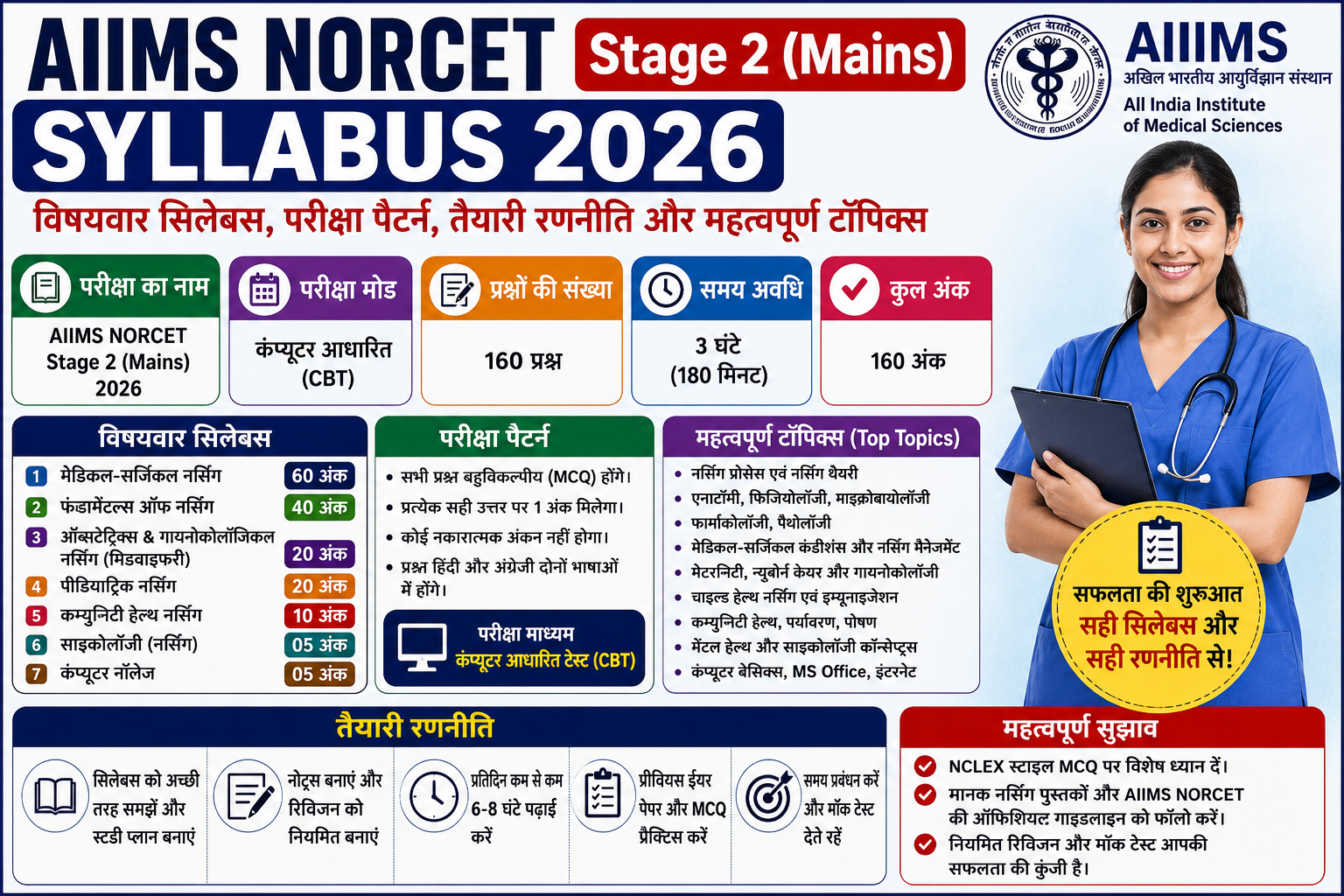
AIIMS NORCET Stage 2 (Mains) 2026 नर्सिंग ऑफिसर भर्ती की सबसे महत्वपूर्ण परीक्षा है। इसी चरण के अंकों के आधार पर अंतिम मेरिट सूची तैयार की जाती है। इसलिए जो उम्मीदवार Stage 1 (Preliminary) पास करते हैं, उन्हें Stage 2 की तैयारी पूरी रणनीति के साथ करनी चाहिए।
यह परीक्षा Computer-Based Test (CBT) होती है, जिसमें 160 बहुविकल्पीय प्रश्न (MCQs) पूछे जाते हैं। प्रश्न पूरी तरह B.Sc. Nursing, Post Basic B.Sc. Nursing और GNM स्तर के सिलेबस पर आधारित होते हैं। हाल के NORCET परीक्षा चक्रों में अधिकतर प्रश्न Case Scenario, Clinical Judgment, Priority of Care और Nursing Process पर आधारित पूछे गए हैं। कई बार प्रश्नों में चित्र (Images) और छोटे वीडियो आधारित Clinical Situations भी शामिल किए जाते हैं।
इस लेख में AIIMS NORCET Stage 2 Syllabus 2026, परीक्षा पैटर्न, विषयवार महत्वपूर्ण टॉपिक्स, तैयारी की रणनीति और सफलता के लिए जरूरी टिप्स विस्तार से दिए गए हैं।
AIIMS NORCET Stage 2 Exam Pattern 2026
| पैरामीटर | विवरण |
|---|---|
| परीक्षा का प्रकार | Computer Based Test (CBT) |
| कुल प्रश्न | 160 MCQs |
| कुल अंक | 160 |
| परीक्षा अवधि | 180 मिनट |
| सेक्शन | सामान्यतः 4 Sequential Sections (40 प्रश्न × 45 मिनट) |
| सेक्शन बदलने का नियम | Backtracking की अनुमति नहीं |
| सही उत्तर | +1 अंक |
| गलत उत्तर | –1/3 अंक |
| प्रश्नों का स्तर | Clinical Application एवं Nursing Subjects |
महत्वपूर्ण बात
AIIMS Stage 2 के लिए अलग से विस्तृत टॉपिक-वाइज आधिकारिक सिलेबस जारी नहीं करता। पूरा सिलेबस B.Sc. Nursing, Post Basic B.Sc. Nursing एवं GNM के संपूर्ण पाठ्यक्रम पर आधारित होता है।
AIIMS NORCET Stage 2 Syllabus 2026
Stage 2 में लगभग पूरा फोकस Nursing Subjects पर रहता है। नीचे सभी महत्वपूर्ण विषय और उनसे जुड़े हाई-वेटेज टॉपिक्स दिए गए हैं।
1. Medical-Surgical Nursing (सबसे अधिक वेटेज)
Medical-Surgical Nursing Stage 2 का सबसे महत्वपूर्ण विषय माना जाता है। लगभग 30 से 35 प्रतिशत प्रश्न इसी विषय से पूछे जाते हैं।
Cardiovascular System
- Myocardial Infarction (MI)
- ECG Changes
- Heart Failure
- Hypertension
- Arrhythmias
- Cardiac Catheterization Nursing Care
Respiratory System
- COPD
- Asthma
- Pneumonia
- ARDS
- ABG Interpretation
- Chest Tube Drainage
- Mechanical Ventilation Basics
Neurology
- Stroke (Ischemic एवं Hemorrhagic)
- Glasgow Coma Scale (GCS)
- Raised Intracranial Pressure
- Seizures
- Meningitis
- Spinal Cord Injury
Renal एवं Urinary Disorders
- Acute Kidney Disease
- Chronic Kidney Disease
- Dialysis Care
- Urinary Tract Infection
- Fluid एवं Electrolyte Balance
- Acid Base Balance
Gastrointestinal Disorders
- Peptic Ulcer
- Liver Cirrhosis
- Hepatitis
- Pancreatitis
- Inflammatory Bowel Disease
- Colostomy Care
Endocrine Disorders
- Diabetes Mellitus
- Diabetic Ketoacidosis (DKA)
- Hyperosmolar Hyperglycemic State (HHS)
- Insulin Therapy
- Thyroid Disorders
- Cushing Syndrome
- Addison Disease
Musculoskeletal एवं Oncology
- Fractures
- Osteoarthritis
- Rheumatoid Arthritis
- Chemotherapy Side Effects
- Radiation Therapy Care
- Cancer Nursing
Emergency एवं ICU
- Triage Color Coding
- BLS
- ACLS
- Shock के सभी प्रकार
- Burns
- Poisoning
- Multiple Trauma Management
2. Fundamentals of Nursing
इस विषय से हर वर्ष अच्छे अंक प्राप्त किए जा सकते हैं।
महत्वपूर्ण टॉपिक्स—
- Nursing Process
- Assessment
- Nursing Diagnosis
- Planning
- Implementation
- Evaluation
- Infection Control
- Standard Precautions
- PPE
- Biomedical Waste Management (नवीनतम Color Coding)
- Vital Signs
- Pain Management
- Patient Positioning
- Mobility
- Catheterization
- NG Tube Insertion
- Tracheostomy Care
- Wound Dressing
- IV Therapy
- Drug एवं Fluid Calculation
- Documentation
- Patient Rights
- Legal एवं Ethical Issues
- Restraints
- Patient Safety
3. Obstetrics & Gynaecological Nursing (Midwifery)
महत्वपूर्ण टॉपिक्स—
- Antenatal Care
- Intranatal Care
- Postnatal Care
- Stages of Labour
- Partograph Interpretation
- Postpartum Hemorrhage (PPH)
- Pre-eclampsia
- Eclampsia
- Cord Prolapse
- Shoulder Dystocia
- Fetal Monitoring
- APGAR Score
- Family Planning
- High Risk Pregnancy
- Newborn Care
- PID
- Fibroids
- Menstrual Disorders
- Hysterectomy Nursing Care
4. Pediatric Nursing
महत्वपूर्ण विषय—
- Growth एवं Development Milestones
- National Immunization Schedule
- Neonatal Resuscitation
- Common Neonatal Problems
- Diarrhoea
- Pneumonia
- Measles
- Malnutrition
- Congenital Anomalies
- Pediatric Emergencies
- Child Rights
- IMNCI
5. Community Health Nursing
इस विषय से National Health Programmes पर नियमित प्रश्न पूछे जाते हैं।
महत्वपूर्ण टॉपिक्स—
- National Health Mission (NHM)
- Reproductive & Child Health (RCH)
- National TB Elimination Programme
- National AIDS Control Programme
- Epidemiology
- Communicable Diseases
- Non-Communicable Diseases
- Primary Health Care
- Levels of Prevention
- Maternal एवं Child Health Services
- Family Welfare
- Environmental Health
- Occupational Health
- Health Education
- Communication
6. Mental Health Nursing
महत्वपूर्ण टॉपिक्स—
- Schizophrenia
- Depression
- Bipolar Disorder
- Anxiety Disorders
- Defense Mechanisms
- Therapeutic Communication
- Nursing Interventions
- Psychotropic Drugs
- Drug Side Effects
- Psychiatric Emergencies
- Suicide Risk Assessment
- Community Mental Health
7. Pharmacology
इस विषय में Clinical Application आधारित प्रश्न अधिक पूछे जाते हैं।
महत्वपूर्ण टॉपिक्स—
- Antibiotics
- Antihypertensive Drugs
- Insulin
- Anticoagulants
- Opioids
- Drug Interactions
- Drug Side Effects
- Dosage Calculation
- Nursing Implications
8. Nursing Management & Administration
महत्वपूर्ण विषय—
- Leadership Styles
- Motivation Theories
- Staffing
- Inventory Management
- Quality Assurance
- Hospital Organization
- Ward Management
- Communication
- Conflict Management
- Supervision
अन्य महत्वपूर्ण विषय
इन विषयों से कम प्रश्न आते हैं, लेकिन अच्छे अंक दिला सकते हैं।
- Applied Anatomy
- Physiology
- Microbiology
- Nutrition एवं Dietetics
- Therapeutic Diet
- First Aid
- Emergency Care
- Nursing Research
- Statistics
- Psychology
- Sociology
AIIMS NORCET Stage 2 Preparation Strategy 2026
यदि आप Stage 2 में अच्छा स्कोर करना चाहते हैं, तो केवल किताबें पढ़ना पर्याप्त नहीं होगा। आपको Clinical Thinking विकसित करनी होगी।
Clinical Judgment पर ध्यान दें
अधिकांश प्रश्न इस प्रकार पूछे जाते हैं—
- सबसे पहले क्या करना चाहिए?
- किस मरीज को प्राथमिकता मिलेगी?
- सही Nursing Intervention कौन सा है?
- इस Clinical Finding का क्या अर्थ है?
ऐसे प्रश्नों की नियमित प्रैक्टिस करें।
विषयों की प्राथमिकता
तैयारी करते समय विषयों का क्रम इस प्रकार रखें—
- Medical-Surgical Nursing
- Fundamentals of Nursing
- Obstetrics & Gynaecology
- Pediatric Nursing
- Community Health Nursing
- Mental Health Nursing
- Pharmacology
- Nursing Management
प्रतिदिन की अध्ययन योजना
हर दिन—
- एक पूरा सिस्टम या विषय विस्तार से पढ़ें।
- उसके Clinical Application को समझें।
- 50 से 80 Previous Year Questions या उच्च गुणवत्ता वाले Mock Questions हल करें।
- Emergency Nursing एवं Priority Action की अलग नोटबुक बनाएं।
- Drug Calculation, ECG तथा ABG Interpretation का नियमित अभ्यास करें।
AIIMS NORCET Stage 2 के लिए उपयोगी किताबें
तैयारी के लिए निम्न मानक पुस्तकों का अध्ययन उपयोगी रहेगा—
- Brunner & Suddarth – Medical Surgical Nursing
- Lewis – Medical Surgical Nursing
- Potter & Perry – Fundamentals of Nursing
- Dutta या Myles – Obstetrics
- Marlow या Wong – Pediatric Nursing
- Townsend – Psychiatric Nursing
- Park – Community Medicine
इसके अलावा—
- विश्वसनीय NORCET Coaching Notes
- Previous Year NORCET Mains Papers
- Quality Mock Tests
- नवीनतम National Health Programmes
- Latest Immunization Schedule (MoHFW)
का भी नियमित अध्ययन करें।
4 से 6 सप्ताह की तैयारी योजना
पहले 2 सप्ताह
- Medical Surgical Nursing
- Fundamentals of Nursing
तीसरा सप्ताह
- Obstetrics
- Pediatrics
- Pharmacology
चौथा सप्ताह
- Community Health Nursing
- Mental Health Nursing
- Nursing Management
अंतिम 10 से 12 दिन
- Full Length Mock Test
- Previous Year Questions
- कमजोर विषयों का Revision
- Priority Action एवं Emergency Notes दोहराएं
सफलता के लिए महत्वपूर्ण टिप्स
- Sequential Sections होने के कारण समय प्रबंधन सबसे महत्वपूर्ण है।
- किसी एक प्रश्न पर अधिक समय न लगाएं।
- Negative Marking होने के कारण केवल उन्हीं प्रश्नों का उत्तर दें जिनमें पर्याप्त विश्वास हो।
- Biomedical Waste Management, National Immunization Schedule, National Health Programmes तथा BLS/ACLS की नवीनतम गाइडलाइन अवश्य पढ़ें।
- Case Scenario आधारित प्रश्नों में “Priority”, “Immediate”, “First” और “Most Appropriate” जैसे शब्दों पर विशेष ध्यान दें, क्योंकि सही उत्तर अक्सर इन्हीं संकेतों पर निर्भर करता है।
- AIIMS द्वारा जारी किसी भी नए निर्देश, परीक्षा अपडेट या स्पष्टीकरण के लिए नियमित रूप से aiimsexams.ac.in वेबसाइट देखते रहें।
Medical-Surgical Nursing Practice Questions (MCQ 1–40)
Difficulty Level: NORCET Stage 2 (Clinical Scenario Based)
Pattern: AIIMS NORCET Mains | Case-Based | Priority Nursing Action
Q1. A 58-year-old patient arrives in the emergency department with severe chest pain radiating to the left arm. The ECG shows ST-segment elevation. What should be the nurse’s priority action?
A. Administer IV antibiotics
B. Obtain blood sugar level
C. Administer oxygen and inform the physician immediately
D. Encourage oral fluids
Correct Answer: ✅ C. Administer oxygen and inform the physician immediately
Explanation: ST-segment elevation indicates acute myocardial infarction (STEMI). Immediate oxygen (if indicated), cardiac monitoring, and rapid medical intervention are priorities.
Q2. Which ECG finding is most commonly associated with Hyperkalemia?
A. Tall peaked T waves
B. U waves
C. Prolonged QT interval
D. ST depression
Correct Answer: ✅ A. Tall peaked T waves
Explanation: Hyperkalemia characteristically causes tall, peaked T waves and may progress to widened QRS complexes.
Q3. A patient with COPD is receiving oxygen therapy. Which oxygen flow rate is generally preferred initially?
A. 8–10 L/min
B. 6–8 L/min
C. 1–2 L/min via nasal cannula
D. 15 L/min
Correct Answer: ✅ C. 1–2 L/min via nasal cannula
Explanation: Excessive oxygen can suppress the hypoxic respiratory drive in some COPD patients. Low-flow oxygen is usually preferred initially.
Q4. Which ABG result indicates Respiratory Acidosis?
A. pH 7.30, PaCO₂ 55 mmHg
B. pH 7.50, PaCO₂ 28 mmHg
C. pH 7.48, HCO₃ 30 mEq/L
D. pH 7.28, HCO₃ 18 mEq/L
Correct Answer: ✅ A. pH 7.30, PaCO₂ 55 mmHg
Explanation: Low pH with elevated PaCO₂ indicates respiratory acidosis.
Q5. A nurse is caring for a patient with increased intracranial pressure. Which action should be avoided?
A. Elevate the head of bed to 30°
B. Maintain neck alignment
C. Frequent vigorous suctioning
D. Administer prescribed mannitol
Correct Answer: ✅ C. Frequent vigorous suctioning
Explanation: Vigorous suctioning increases intracranial pressure and should be minimized.
Q6. Which assessment finding is the earliest sign of hypovolemic shock?
A. Bradycardia
B. Tachycardia
C. Cyanosis
D. Anuria
Correct Answer: ✅ B. Tachycardia
Explanation: Tachycardia is the earliest compensatory response to hypovolemia.
Q7. A patient with chronic kidney disease is receiving hemodialysis. Which assessment finding requires immediate intervention?
A. Mild fatigue
B. Blood pressure 80/50 mmHg
C. Slight nausea
D. Dry skin
Correct Answer: ✅ B. Blood pressure 80/50 mmHg
Explanation: Severe hypotension during dialysis is a medical emergency.
Q8. Which electrolyte imbalance is most commonly seen in chronic renal failure?
A. Hypokalemia
B. Hyperkalemia
C. Hypernatremia
D. Hypocalcemia only
Correct Answer: ✅ B. Hyperkalemia
Q9. Which insulin has the fastest onset of action?
A. Glargine
B. Lispro
C. NPH
D. Detemir
Correct Answer: ✅ B. Lispro
Explanation: Lispro is a rapid-acting insulin with an onset of about 10–15 minutes.
Q10. Which condition is considered a medical emergency in diabetic patients?
A. Mild hypoglycemia
B. DKA
C. Stable diabetes
D. Controlled hypertension
Correct Answer: ✅ B. DKA
Q11. A burn patient weighs 70 kg. According to the Parkland Formula, what is the total fluid requirement in the first 24 hours for a 30% TBSA burn?
A. 4200 mL
B. 5600 mL
C. 8400 mL
D. 9600 mL
Correct Answer: ✅ C. 8400 mL
Explanation: Parkland Formula = 4 × Body Weight × %TBSA
= 4 × 70 × 30 = 8400 mL
Q12. Which patient should the nurse assess first?
A. Patient with BP 150/90
B. Patient with SpO₂ 84%
C. Patient requesting pain medicine
D. Patient awaiting discharge
Correct Answer: ✅ B. Patient with SpO₂ 84%
Explanation: Airway and breathing always take priority (ABC principle).
Q13. A patient suddenly develops unequal pupils after head injury. What should the nurse suspect?
A. Hypoglycemia
B. Increased intracranial pressure
C. Dehydration
D. Anxiety
Correct Answer: ✅ B. Increased intracranial pressure
Q14. Which type of shock is characterized by widespread vasodilation?
A. Hypovolemic
B. Cardiogenic
C. Septic
D. Obstructive
Correct Answer: ✅ C. Septic
Q15. A patient with liver cirrhosis is most likely to develop:
A. Polycythemia
B. Ascites
C. Hyperthyroidism
D. Hypercalcemia
Correct Answer: ✅ B. Ascites
Q16. Which nursing intervention is most important for a patient with chest tube drainage?
A. Clamp the tube routinely
B. Keep drainage system below chest level
C. Milk the tube every hour
D. Disconnect tube during transport
Correct Answer: ✅ B. Keep drainage system below chest level
Q17. Which Glasgow Coma Scale (GCS) score indicates severe head injury?
A. 14
B. 12
C. 10
D. 7
Correct Answer: ✅ D. 7
Explanation: A GCS score of 8 or below indicates severe brain injury.
Q18. Which patient is at the highest risk for Deep Vein Thrombosis (DVT)?
A. Young athlete
B. Postoperative immobile patient
C. School student
D. Healthy adult
Correct Answer: ✅ B. Postoperative immobile patient
Q19. Which symptom is most characteristic of left-sided heart failure?
A. Pedal edema only
B. Pulmonary edema
C. Hepatomegaly
D. Ascites
Correct Answer: ✅ B. Pulmonary edema
Q20. A nurse is caring for a patient with acute asthma who suddenly becomes silent on auscultation. What does this finding indicate?
A. Improvement
B. Mild bronchospasm
C. Severe airway obstruction requiring immediate intervention
D. Normal finding
Correct Answer: ✅ C. Severe airway obstruction requiring immediate intervention
Explanation: A “silent chest” in an asthma patient is a life-threatening sign of minimal air movement and impending respiratory failure. Immediate emergency management is required.
Q21. A patient admitted with Acute Myocardial Infarction suddenly develops ventricular fibrillation. What should the nurse do first?
A. Start chest physiotherapy
B. Administer IV antibiotics
C. Begin CPR and prepare for immediate defibrillation
D. Give oral aspirin
✅ Correct Answer: C. Begin CPR and prepare for immediate defibrillation
Explanation: Ventricular fibrillation is a shockable rhythm. Immediate CPR and early defibrillation offer the best chance of survival.
Q22. A patient with left-sided heart failure suddenly complains of severe breathlessness. Which nursing intervention should be performed first?
A. Lay the patient flat on the bed
B. Place the patient in High Fowler’s position
C. Encourage oral fluids
D. Cover the patient with a blanket
✅ Correct Answer: B. Place the patient in High Fowler’s position
Explanation: High Fowler’s position decreases venous return and improves lung expansion, helping relieve pulmonary congestion.
Q23. Which electrolyte imbalance is most likely to cause muscle weakness, paralytic ileus, and flattened T waves on ECG?
A. Hyperkalemia
B. Hypokalemia
C. Hypercalcemia
D. Hypernatremia
✅ Correct Answer: B. Hypokalemia
Q24. A patient with severe burns develops decreased urine output despite adequate fluid replacement. What is the nurse’s priority concern?
A. Anxiety
B. Acute Kidney Injury (AKI)
C. Constipation
D. Hypertension
✅ Correct Answer: B. Acute Kidney Injury (AKI)
Explanation: Reduced urine output after burns may indicate inadequate perfusion or developing AKI.
Q25. Which finding confirms effective chest tube functioning?
A. Continuous bubbling in the water seal chamber without pneumothorax
B. Intermittent tidaling with respiration
C. Drainage system kept above chest level
D. Tube clamped continuously
✅ Correct Answer: B. Intermittent tidaling with respiration
Q26. Which assessment finding is most suggestive of increased intracranial pressure?
A. Bradycardia with hypertension
B. Hypotension with tachycardia
C. Fever only
D. Diarrhea
✅ Correct Answer: A. Bradycardia with hypertension
Explanation: Bradycardia, hypertension, and irregular respirations form Cushing’s triad, indicating increased ICP.
Q27. A patient with diabetic ketoacidosis is admitted. Which electrolyte level requires the closest monitoring during insulin therapy?
A. Sodium
B. Calcium
C. Potassium
D. Magnesium
✅ Correct Answer: C. Potassium
Q28. Which patient has the highest priority according to triage principles?
A. Stable fracture with mild pain
B. Cardiac arrest
C. Minor burn on hand
D. Fever for two days
✅ Correct Answer: B. Cardiac arrest
Q29. A patient with COPD suddenly becomes restless and confused. What is the nurse’s first action?
A. Administer sedatives
B. Assess oxygen saturation immediately
C. Encourage sleep
D. Give oral fluids
✅ Correct Answer: B. Assess oxygen saturation immediately
Explanation: Restlessness is often an early sign of hypoxia.
Q30. Which ABG finding represents metabolic alkalosis?
A. pH 7.50, HCO₃⁻ 34 mEq/L
B. pH 7.30, PaCO₂ 60 mmHg
C. pH 7.28, HCO₃⁻ 18 mEq/L
D. pH 7.36, PaCO₂ 40 mmHg
✅ Correct Answer: A. pH 7.50, HCO₃⁻ 34 mEq/L
Q31. A nurse is caring for a patient with seizure disorder. Which nursing action is appropriate during an active seizure?
A. Insert an oral airway immediately
B. Restrict all body movements
C. Turn the patient to the side and protect the head
D. Give food after seizure begins
✅ Correct Answer: C. Turn the patient to the side and protect the head
Q32. Which burn patient should receive the highest priority?
A. First-degree burn over 5% TBSA
B. Superficial burn on forearm
C. Electrical burn with cardiac arrhythmia
D. Minor scald burn
✅ Correct Answer: C. Electrical burn with cardiac arrhythmia
Q33. A patient is receiving blood transfusion. After 10 minutes, fever, chills, and back pain develop. What is the nurse’s first action?
A. Increase infusion rate
B. Stop the transfusion immediately
C. Administer antibiotics
D. Continue transfusion slowly
✅ Correct Answer: B. Stop the transfusion immediately
Q34. Which ECG change is most commonly associated with hypokalemia?
A. Peaked T wave
B. U wave
C. ST elevation
D. Wide QRS complex
✅ Correct Answer: B. U wave
Q35. Which symptom is most characteristic of hypocalcemia?
A. Constipation
B. Positive Chvostek’s sign
C. Bradycardia
D. Dry cough
✅ Correct Answer: B. Positive Chvostek’s sign
Q36. Which patient is at the greatest risk of developing pulmonary embolism?
A. Healthy young athlete
B. Long-term bedridden postoperative patient
C. School-going child
D. Controlled diabetic patient
✅ Correct Answer: B. Long-term bedridden postoperative patient
Q37. Which nursing intervention is most important for preventing ventilator-associated pneumonia (VAP)?
A. Keep patient flat
B. Elevate head of bed to 30–45°
C. Restrict oral care
D. Avoid suctioning
✅ Correct Answer: B. Elevate head of bed to 30–45°
Q38. Which assessment finding indicates fluid volume overload?
A. Sunken eyes
B. Weight gain with bilateral edema
C. Dry tongue
D. Hypotension
✅ Correct Answer: B. Weight gain with bilateral edema
Q39. A patient with stroke suddenly develops difficulty swallowing. What should the nurse do first?
A. Give oral medication immediately
B. Perform a swallowing assessment before oral intake
C. Encourage drinking water
D. Offer a soft diet
✅ Correct Answer: B. Perform a swallowing assessment before oral intake
Q40. A patient receiving heparin develops bleeding gums and hematuria. Which antidote should the nurse anticipate administering?
A. Vitamin K
B. Protamine sulfate
C. Naloxone
D. Atropine
✅ Correct Answer: B. Protamine sulfate
Explanation: Protamine sulfate is the specific antidote for heparin overdose. Vitamin K is used to reverse warfarin.
Fundamentals of Nursing Practice Questions (MCQ 1–20)
Q1. A nurse enters a patient’s room before administering medication. What is the first step to ensure patient safety?
A. Check the medication label
B. Ask the patient about allergies
C. Verify the patient’s identity using two identifiers
D. Measure vital signs
✅ Correct Answer: C. Verify the patient’s identity using two identifiers
Explanation: Patient identification using at least two identifiers is the first step in preventing medication errors.
Q2. While assessing a postoperative patient, the nurse notices sudden restlessness and anxiety. What should be the nurse’s priority action?
A. Administer a sedative
B. Assess oxygen saturation and airway status
C. Encourage the patient to sleep
D. Call the patient’s relatives
✅ Correct Answer: B. Assess oxygen saturation and airway status
Explanation: Restlessness is often the earliest sign of hypoxia. Airway and breathing should always be assessed first.
Q3. Which of the following is the correct sequence of the Nursing Process?
A. Planning → Assessment → Diagnosis → Evaluation → Implementation
B. Assessment → Diagnosis → Planning → Implementation → Evaluation
C. Diagnosis → Assessment → Planning → Evaluation → Implementation
D. Assessment → Planning → Diagnosis → Implementation → Evaluation
✅ Correct Answer: B. Assessment → Diagnosis → Planning → Implementation → Evaluation
Q4. During hand hygiene, soap and water are preferred over alcohol-based hand rub when hands are:
A. Dry
B. Visibly dirty or contaminated with body fluids
C. Before touching a patient
D. After removing gloves
✅ Correct Answer: B. Visibly dirty or contaminated with body fluids
Q5. Which PPE should be worn first while donning?
A. Gloves
B. Gown
C. Face shield
D. Mask
✅ Correct Answer: B. Gown
Explanation: General order: Gown → Mask/Respirator → Goggles/Face Shield → Gloves.
Q6. According to Biomedical Waste Management Rules, a used IV tubing should be discarded in which color-coded container?
A. Yellow
B. Red
C. Blue
D. Black
✅ Correct Answer: B. Red
Explanation: Contaminated recyclable plastic items like IV tubing, catheters, and urine bags are discarded in the Red category.
Q7. Before administering any medication, the nurse should first check:
A. Patient’s diet
B. Medication expiry date and prescription
C. Family history
D. Bed number only
✅ Correct Answer: B. Medication expiry date and prescription
Q8. Which route provides the fastest systemic absorption of medication?
A. Oral
B. Intramuscular
C. Intravenous
D. Subcutaneous
✅ Correct Answer: C. Intravenous
Q9. A patient receiving IV fluids complains of swelling and pain at the insertion site. What is the most likely complication?
A. Air embolism
B. Infiltration
C. Hemorrhage
D. Hypoglycemia
✅ Correct Answer: B. Infiltration
Q10. Which nursing intervention is most effective in preventing pressure ulcers?
A. Restrict oral fluids
B. Reposition the patient every two hours
C. Keep the patient in one position
D. Massage reddened skin vigorously
✅ Correct Answer: B. Reposition the patient every two hours
Q11. A patient is receiving oxygen through a nasal cannula. Which assessment finding requires immediate intervention?
A. Respiratory rate of 18/min
B. Oxygen saturation of 97%
C. Dry nasal mucosa with mild discomfort
D. Oxygen tubing disconnected from the oxygen source
✅ Correct Answer: D. Oxygen tubing disconnected from the oxygen source
Q12. Which pulse site is preferred during cardiopulmonary resuscitation (CPR) in adults?
A. Radial artery
B. Brachial artery
C. Carotid artery
D. Temporal artery
✅ Correct Answer: C. Carotid artery
Q13. A nurse is preparing to insert a nasogastric (NG) tube. Which position is most appropriate?
A. Supine
B. High Fowler’s position
C. Trendelenburg position
D. Prone
✅ Correct Answer: B. High Fowler’s position
Q14. The primary purpose of using restraints is to:
A. Punish aggressive patients
B. Prevent injury when less restrictive measures have failed
C. Reduce nursing workload
D. Improve patient comfort
✅ Correct Answer: B. Prevent injury when less restrictive measures have failed
Q15. Which of the following is considered a normal adult urine output?
A. 10–20 mL/hour
B. 30–50 mL/hour
C. 5–10 mL/hour
D. Less than 15 mL/hour
✅ Correct Answer: B. 30–50 mL/hour
Q16. While transferring a patient from bed to wheelchair, the nurse should first:
A. Pull the patient by the arms
B. Lock the wheelchair brakes
C. Ask the patient to stand immediately
D. Raise the side rails
✅ Correct Answer: B. Lock the wheelchair brakes
Q17. A patient accidentally receives the wrong medication. What is the nurse’s first action?
A. Hide the incident
B. Immediately assess the patient’s condition and inform the physician
C. Wait for symptoms to appear
D. Replace the medication quietly
✅ Correct Answer: B. Immediately assess the patient’s condition and inform the physician
Q18. Which of the following is an example of a subjective assessment?
A. Blood pressure is 120/80 mmHg
B. Temperature is 38°C
C. Patient reports severe chest pain
D. Pulse rate is 84/min
✅ Correct Answer: C. Patient reports severe chest pain
Q19. Which nursing action helps prevent catheter-associated urinary tract infection (CAUTI)?
A. Disconnect the catheter frequently
B. Keep the drainage bag below bladder level
C. Irrigate the catheter daily without indication
D. Empty the drainage bag once every 24 hours
✅ Correct Answer: B. Keep the drainage bag below bladder level
Q20. A patient suddenly becomes unconscious while eating. What should the nurse assess first?
A. Blood pressure
B. Airway patency
C. Body temperature
D. Urine output
✅ Correct Answer: B. Airway patency
Explanation: According to the ABC (Airway, Breathing, Circulation) approach, maintaining a patent airway is the first priority in an unconscious patient.
Obstetrics & Gynaecological Nursing (Midwifery) Practice Questions (MCQ 1–20)
Q1. A woman at 39 weeks of gestation suddenly develops heavy vaginal bleeding with severe abdominal pain. The uterus is rigid and tender. What is the most likely diagnosis?
A. Placenta previa
B. Abruptio placentae
C. Ectopic pregnancy
D. Uterine fibroid
✅ Correct Answer: B. Abruptio placentae
Explanation: Painful vaginal bleeding with a rigid, tender uterus is a classic sign of abruptio placentae.
Q2. During the second stage of labor, the fetal heart rate suddenly drops to 80 beats/min after rupture of membranes. What should the nurse suspect first?
A. Placenta previa
B. Cord prolapse
C. Postpartum hemorrhage
D. Uterine rupture
✅ Correct Answer: B. Cord prolapse
Explanation: Sudden fetal bradycardia after membrane rupture strongly suggests umbilical cord prolapse.
Q3. A primigravida develops BP 170/110 mmHg, severe headache, blurred vision, and proteinuria. What is the priority nursing action?
A. Encourage ambulation
B. Prepare for magnesium sulfate administration as prescribed and notify the obstetrician
C. Give oral glucose solution
D. Start oxytocin infusion
✅ Correct Answer: B. Prepare for magnesium sulfate administration as prescribed and notify the obstetrician
Q4. Which drug is the first-line medication for preventing seizures in severe pre-eclampsia and eclampsia?
A. Diazepam
B. Magnesium sulfate
C. Oxytocin
D. Methylergometrine
✅ Correct Answer: B. Magnesium sulfate
Q5. Which APGAR score parameter assesses the newborn’s muscle tone?
A. Heart rate
B. Reflex irritability
C. Activity
D. Respiration
✅ Correct Answer: C. Activity
Q6. The normal fetal heart rate ranges between:
A. 80–100 beats/min
B. 100–120 beats/min
C. 110–160 beats/min
D. 170–190 beats/min
✅ Correct Answer: C. 110–160 beats/min
Q7. A woman develops excessive bleeding immediately after delivery. The uterus feels soft and boggy. What should the nurse do first?
A. Insert a urinary catheter only
B. Massage the uterine fundus
C. Give oral fluids
D. Place the patient in Trendelenburg position only
✅ Correct Answer: B. Massage the uterine fundus
Explanation: Uterine atony is the most common cause of postpartum hemorrhage. Fundal massage is the immediate nursing intervention.
Q8. Which stage of labor begins with complete cervical dilatation and ends with the birth of the baby?
A. First stage
B. Second stage
C. Third stage
D. Fourth stage
✅ Correct Answer: B. Second stage
Q9. Which color of amniotic fluid suggests fetal distress?
A. Clear
B. Straw-colored
C. Green (meconium-stained)
D. Pink
✅ Correct Answer: C. Green (meconium-stained)
Q10. During antenatal assessment, which finding requires immediate reporting?
A. Mild ankle edema in the evening
B. Persistent severe headache with blurred vision
C. Mild nausea during the first trimester
D. Occasional fetal hiccups
✅ Correct Answer: B. Persistent severe headache with blurred vision
Q11. Which maneuver is commonly used to relieve shoulder dystocia?
A. McRoberts maneuver
B. Heimlich maneuver
C. Valsalva maneuver
D. Trendelenburg maneuver
✅ Correct Answer: A. McRoberts maneuver
Q12. A postpartum mother complains of severe calf pain, redness, and swelling. What should the nurse suspect?
A. Mastitis
B. Deep Vein Thrombosis (DVT)
C. Endometritis
D. Urinary tract infection
✅ Correct Answer: B. Deep Vein Thrombosis (DVT)
Q13. Which hormone is primarily responsible for uterine contractions during labor?
A. Estrogen
B. Progesterone
C. Oxytocin
D. Prolactin
✅ Correct Answer: C. Oxytocin
Q14. The partograph is primarily used to:
A. Assess fetal anomalies
B. Monitor the progress of labor
C. Calculate expected date of delivery
D. Measure fetal weight
✅ Correct Answer: B. Monitor the progress of labor
Q15. Immediately after birth, what is the nurse’s first priority in caring for the newborn?
A. Administer Vitamin K
B. Ensure airway patency and effective breathing
C. Weigh the newborn
D. Give the first bath
✅ Correct Answer: B. Ensure airway patency and effective breathing
Explanation: According to neonatal resuscitation principles, establishing airway and breathing is the first priority.
Q16. Which condition is an absolute obstetric emergency?
A. Mild anemia
B. Placenta previa with painless bleeding at term
C. Cord prolapse with fetal bradycardia
D. Morning sickness
✅ Correct Answer: C. Cord prolapse with fetal bradycardia
Q17. A woman at 34 weeks gestation reports leaking of clear fluid without contractions. What is the most likely diagnosis?
A. Placental abruption
B. Premature Rupture of Membranes (PROM)
C. Ectopic pregnancy
D. Hyperemesis gravidarum
✅ Correct Answer: B. Premature Rupture of Membranes (PROM)
Q18. Which contraceptive method provides the best protection against sexually transmitted infections (STIs)?
A. Copper-T (IUCD)
B. Oral contraceptive pills
C. Male condom
D. Injectable contraceptive
✅ Correct Answer: C. Male condom
Q19. Which postpartum assessment finding indicates normal uterine involution?
A. Boggy uterus with heavy bleeding
B. Fundus firm and at the level expected for the postpartum day
C. Continuous severe abdominal pain
D. Persistent foul-smelling lochia
✅ Correct Answer: B. Fundus firm and at the level expected for the postpartum day
Q20. A nurse is caring for a woman receiving magnesium sulfate therapy. Which assessment finding requires immediate intervention?
A. Respiratory rate of 10/min
B. Blood pressure of 150/90 mmHg
C. Mild facial flushing
D. Urine output of 40 mL/hour
✅ Correct Answer: A. Respiratory rate of 10/min
Explanation: Respiratory depression is a serious sign of magnesium sulfate toxicity. The nurse should stop the infusion (as per protocol), notify the physician immediately, and prepare calcium gluconate, the antidote.
Pediatric Nursing Practice Questions (MCQ 1–20)
Q1. A 2-year-old child is brought to the emergency department with severe dehydration due to acute diarrhea. The child is lethargic, has sunken eyes, and a weak pulse. What is the nurse’s priority action?
A. Start oral feeding immediately
B. Assess airway, breathing, circulation, and initiate fluid resuscitation as prescribed
C. Administer antibiotics immediately
D. Weigh the child first
✅ Correct Answer: B. Assess airway, breathing, circulation, and initiate fluid resuscitation as prescribed
Explanation: In severe dehydration, maintaining ABC (Airway, Breathing, Circulation) and restoring circulating volume are the highest priorities.
Q2. According to the National Immunization Schedule (India), the BCG vaccine is primarily given to protect against:
A. Diphtheria
B. Tuberculosis
C. Hepatitis B
D. Measles
✅ Correct Answer: B. Tuberculosis
Q3. A newborn has an APGAR score of 5 at one minute. What is the nurse’s immediate priority?
A. Administer Vitamin K
B. Initiate appropriate neonatal resuscitation measures
C. Give the newborn to the mother for breastfeeding
D. Weigh the newborn
✅ Correct Answer: B. Initiate appropriate neonatal resuscitation measures
Q4. Which developmental milestone is normally achieved by a 6-month-old infant?
A. Walks independently
B. Rolls over from front to back and back to front
C. Speaks two-word sentences
D. Climbs stairs
✅ Correct Answer: B. Rolls over from front to back and back to front
Q5. A child presents with barking cough, inspiratory stridor, and hoarseness. What is the most likely diagnosis?
A. Bronchial asthma
B. Croup (Acute Laryngotracheobronchitis)
C. Bronchiolitis
D. Pneumonia
✅ Correct Answer: B. Croup (Acute Laryngotracheobronchitis)
Q6. Which assessment finding is the earliest sign of respiratory distress in infants?
A. Cyanosis
B. Bradypnea
C. Nasal flaring
D. Cardiac arrest
✅ Correct Answer: C. Nasal flaring
Q7. A nurse is caring for a child with febrile seizures. What should be the first nursing action during the seizure?
A. Insert a tongue depressor into the mouth
B. Hold the child tightly
C. Protect the child from injury and maintain airway patency
D. Give oral medication immediately
✅ Correct Answer: C. Protect the child from injury and maintain airway patency
Q8. Which vitamin deficiency is the primary cause of Rickets?
A. Vitamin A
B. Vitamin C
C. Vitamin D
D. Vitamin K
✅ Correct Answer: C. Vitamin D
Q9. A 5-year-old child accidentally swallows kerosene. What should the nurse advise first?
A. Induce vomiting immediately
B. Give milk to drink
C. Keep the child nil by mouth and seek immediate medical care
D. Give activated charcoal at home
✅ Correct Answer: C. Keep the child nil by mouth and seek immediate medical care
Explanation: Vomiting should not be induced after hydrocarbon ingestion due to the risk of aspiration.
Q10. Which congenital heart disease is commonly referred to as the “Blue Baby Syndrome”?
A. Ventricular Septal Defect (VSD)
B. Patent Ductus Arteriosus (PDA)
C. Tetralogy of Fallot (TOF)
D. Atrial Septal Defect (ASD)
✅ Correct Answer: C. Tetralogy of Fallot (TOF)
Q11. A child with Tetralogy of Fallot suddenly develops severe cyanosis after crying. What is the nurse’s priority intervention?
A. Lay the child flat
B. Place the child in the knee-chest position and administer oxygen as prescribed
C. Encourage walking
D. Give oral fluids immediately
✅ Correct Answer: B. Place the child in the knee-chest position and administer oxygen as prescribed
Q12. Which vaccine is administered at birth according to India’s Universal Immunization Programme?
A. MMR only
B. BCG, OPV-0, and Hepatitis B Birth Dose
C. DPT only
D. Pentavalent vaccine
✅ Correct Answer: B. BCG, OPV-0, and Hepatitis B Birth Dose
Q13. A nurse is assessing a child with severe acute malnutrition (SAM). Which finding indicates the child is at greatest risk?
A. Weight appropriate for age
B. Bilateral pitting edema and poor appetite
C. Mild fever only
D. Occasional cough
✅ Correct Answer: B. Bilateral pitting edema and poor appetite
Q14. Which is the most common cause of dehydration in children?
A. Hypertension
B. Acute diarrhea
C. Asthma
D. Fracture
✅ Correct Answer: B. Acute diarrhea
Q15. A child with suspected meningitis develops neck stiffness and photophobia. What should be the nurse’s priority action?
A. Encourage bright lighting
B. Implement seizure precautions and notify the physician immediately
C. Allow unrestricted visitors
D. Encourage vigorous exercise
✅ Correct Answer: B. Implement seizure precautions and notify the physician immediately
Q16. Which communication technique is most appropriate when caring for a preschool child?
A. Use complex medical terminology
B. Give lengthy explanations
C. Use simple words, play, and visual aids
D. Avoid interaction
✅ Correct Answer: C. Use simple words, play, and visual aids
Q17. According to the IMNCI approach, which sign indicates severe pneumonia requiring urgent referral?
A. Mild cough only
B. Chest indrawing or general danger signs
C. Runny nose only
D. Sneezing
✅ Correct Answer: B. Chest indrawing or general danger signs
Q18. Which finding suggests increased intracranial pressure in an infant?
A. Sunken anterior fontanelle
B. Bulging anterior fontanelle
C. Soft abdomen
D. Normal Moro reflex
✅ Correct Answer: B. Bulging anterior fontanelle
Q19. A nurse is calculating the dose of oral paracetamol for a child. Which principle is most important?
A. Use the adult dose
B. Calculate the dose according to the child’s weight as prescribed
C. Estimate the dose visually
D. Double the infant dose
✅ Correct Answer: B. Calculate the dose according to the child’s weight as prescribed
Q20. A 3-year-old child is choking and unable to speak or cough. What is the nurse’s first action?
A. Give water immediately
B. Perform age-appropriate abdominal thrusts (if indicated) and activate emergency response
C. Wait for spontaneous recovery
D. Lay the child flat and observe
✅ Correct Answer: B. Perform age-appropriate abdominal thrusts (if indicated) and activate emergency response
Explanation: Complete airway obstruction is a life-threatening emergency. Immediate age-appropriate choking management should be initiated according to current Basic Life Support (BLS) guidelines.
Community Health Nursing Practice Questions (MCQ 1–20)
Q1. A community health nurse identifies three children in a village with suspected measles. What is the nurse’s priority action?
A. Advise home remedies only
B. Notify the appropriate public health authority and initiate outbreak control measures
C. Wait for laboratory confirmation before taking any action
D. Refer all children to a private clinic without reporting
✅ Correct Answer: B. Notify the appropriate public health authority and initiate outbreak control measures
Explanation: Measles is a notifiable disease. Early reporting, isolation, surveillance, and outbreak control measures are essential.
Q2. Which level of prevention includes immunization?
A. Primordial Prevention
B. Primary Prevention
C. Secondary Prevention
D. Tertiary Prevention
✅ Correct Answer: B. Primary Prevention
Q3. Which National Health Programme aims to eliminate tuberculosis in India?
A. National AIDS Control Programme
B. National Tuberculosis Elimination Programme (NTEP)
C. National Leprosy Eradication Programme
D. National Viral Hepatitis Control Programme
✅ Correct Answer: B. National Tuberculosis Elimination Programme (NTEP)
Q4. During a home visit, a nurse finds a child with severe acute diarrhea and signs of dehydration. What is the priority nursing action?
A. Advise oral feeding only
B. Assess dehydration severity and arrange urgent referral if severe while initiating appropriate rehydration as indicated
C. Recommend complete bed rest only
D. Wait until the next scheduled visit
✅ Correct Answer: B. Assess dehydration severity and arrange urgent referral if severe while initiating appropriate rehydration as indicated
Q5. Which vector is responsible for transmitting dengue fever?
A. Anopheles mosquito
B. Aedes mosquito
C. Culex mosquito
D. Sandfly
✅ Correct Answer: B. Aedes mosquito
Q6. Which indicator best reflects the overall health status of a community?
A. Literacy rate alone
B. Infant Mortality Rate (IMR)
C. Number of hospitals only
D. Number of pharmacies
✅ Correct Answer: B. Infant Mortality Rate (IMR)
Q7. A community health nurse is educating villagers about safe drinking water. Which method is most effective for household water disinfection during emergencies?
A. Adding sugar
B. Boiling water adequately before use
C. Keeping water uncovered
D. Filtering through cloth only
✅ Correct Answer: B. Boiling water adequately before use
Q8. Which disease is transmitted through contaminated food and water?
A. Malaria
B. Cholera
C. Dengue
D. Rabies
✅ Correct Answer: B. Cholera
Q9. Which family planning method provides permanent contraception for males?
A. IUCD
B. Oral contraceptive pills
C. Vasectomy
D. Injectable contraceptive
✅ Correct Answer: C. Vasectomy
Q10. Which vitamin deficiency commonly causes Night Blindness?
A. Vitamin A
B. Vitamin B12
C. Vitamin D
D. Vitamin K
✅ Correct Answer: A. Vitamin A
Q11. A patient with pulmonary tuberculosis has been started on anti-TB treatment. Which nursing advice is most important?
A. Stop medication once symptoms improve
B. Complete the full course of treatment exactly as prescribed
C. Take medicines only when fever occurs
D. Avoid follow-up visits
✅ Correct Answer: B. Complete the full course of treatment exactly as prescribed
Q12. Which mosquito primarily transmits malaria?
A. Female Anopheles mosquito
B. Female Aedes mosquito
C. Male Culex mosquito
D. Housefly
✅ Correct Answer: A. Female Anopheles mosquito
Q13. A nurse conducts blood pressure screening in adults to detect hypertension early. This is an example of:
A. Primary Prevention
B. Secondary Prevention
C. Tertiary Prevention
D. Primordial Prevention
✅ Correct Answer: B. Secondary Prevention
Q14. Which health indicator measures deaths of infants under one year of age per 1,000 live births in a year?
A. Maternal Mortality Ratio
B. Infant Mortality Rate
C. Birth Rate
D. Fertility Rate
✅ Correct Answer: B. Infant Mortality Rate
Q15. Which principle is most important while providing health education in the community?
A. Use only medical terminology
B. One-way communication
C. Active participation of the community
D. Avoid demonstrations
✅ Correct Answer: C. Active participation of the community
Q16. A pregnant woman in a remote village develops severe bleeding during pregnancy. What should the community health nurse do first?
A. Advise complete bed rest at home
B. Arrange immediate referral to an appropriate healthcare facility and stabilize as possible
C. Ask her to return after one week
D. Give only oral iron tablets
✅ Correct Answer: B. Arrange immediate referral to an appropriate healthcare facility and stabilize as possible
Q17. Which programme focuses on improving maternal and child health services in India?
A. National Programme for Health Care of the Elderly (NPHCE)
B. Reproductive and Child Health (RCH) Programme
C. National Mental Health Programme
D. National Tobacco Control Programme
✅ Correct Answer: B. Reproductive and Child Health (RCH) Programme
Q18. Which waste disposal method is most appropriate for sharps generated in healthcare settings?
A. Open dumping
B. Disposal in a designated puncture-proof sharps container as per Biomedical Waste Management Rules
C. Burning in open air
D. Disposal with general household waste
✅ Correct Answer: B. Disposal in a designated puncture-proof sharps container as per Biomedical Waste Management Rules
Q19. Which nutritional disorder is caused by iodine deficiency?
A. Pellagra
B. Goiter
C. Scurvy
D. Rickets
✅ Correct Answer: B. Goiter
Q20. During a community outbreak investigation, what is the nurse’s first step?
A. Begin treatment for everyone immediately without assessment
B. Confirm that an outbreak exists and verify the diagnosis according to public health procedures
C. Close all schools immediately
D. Start vaccination without epidemiological assessment
✅ Correct Answer: B. Confirm that an outbreak exists and verify the diagnosis according to public health procedures
Explanation: Outbreak investigations begin by confirming the diagnosis and establishing that an outbreak exists before implementing targeted control measures.
Mental Health (Psychiatric) Nursing Practice Questions (MCQ 1–20)
Q1. A patient with major depressive disorder says, “There is no reason for me to live anymore.” What should be the nurse’s priority action?
A. Tell the patient to think positively.
B. Leave the patient alone to rest.
C. Assess the patient immediately for suicidal thoughts, plan, and intent while ensuring safety.
D. Change the topic to distract the patient.
✅ Correct Answer: C. Assess the patient immediately for suicidal thoughts, plan, and intent while ensuring safety.
Explanation: Any statement suggesting hopelessness or death should be taken seriously. Suicide risk assessment and patient safety are the highest priorities.
Q2. A patient with schizophrenia says, “The television is sending me secret messages.” This statement is an example of:
A. Hallucination
B. Delusion of reference
C. Obsession
D. Phobia
✅ Correct Answer: B. Delusion of reference
Q3. A patient reports hearing voices telling him to harm himself. What is the nurse’s first priority?
A. Ignore the voices and continue routine care.
B. Ask the patient what the voices are saying and assess the risk of acting on them.
C. Tell the patient the voices are not real.
D. Leave the patient alone to reduce stimulation.
✅ Correct Answer: B. Ask the patient what the voices are saying and assess the risk of acting on them.
Q4. Which defense mechanism is demonstrated when a student blames the examiner for poor marks instead of accepting inadequate preparation?
A. Projection
B. Regression
C. Sublimation
D. Denial
✅ Correct Answer: A. Projection
Q5. Which therapeutic communication technique is most appropriate when a patient says, “Nobody understands me.”
A. “That’s not true.”
B. “Tell me more about how you are feeling.”
C. “Don’t worry.”
D. “You should stay busy.”
✅ Correct Answer: B. “Tell me more about how you are feeling.”
Q6. Which symptom is considered a positive symptom of schizophrenia?
A. Social withdrawal
B. Flat affect
C. Auditory hallucinations
D. Lack of motivation
✅ Correct Answer: C. Auditory hallucinations
Q7. A patient taking antipsychotic medication suddenly develops high fever, severe muscle rigidity, altered mental status, and autonomic instability. What should the nurse suspect?
A. Serotonin Syndrome
B. Neuroleptic Malignant Syndrome (NMS)
C. Panic Attack
D. Alcohol Withdrawal
✅ Correct Answer: B. Neuroleptic Malignant Syndrome (NMS)
Explanation: NMS is a life-threatening emergency associated with antipsychotic medications and requires immediate medical intervention.
Q8. Which medication is commonly used as a mood stabilizer in Bipolar Disorder?
A. Fluoxetine
B. Lithium
C. Diazepam
D. Haloperidol
✅ Correct Answer: B. Lithium
Q9. A patient with obsessive-compulsive disorder (OCD) repeatedly washes hands despite no contamination. This behavior is called:
A. Delusion
B. Compulsion
C. Hallucination
D. Illusion
✅ Correct Answer: B. Compulsion
Q10. A patient experiences sudden palpitations, sweating, trembling, and fear of dying without any obvious danger. The most likely diagnosis is:
A. Generalized Anxiety Disorder
B. Panic Attack
C. Schizophrenia
D. Mania
✅ Correct Answer: B. Panic Attack
Q11. Which nursing intervention is most appropriate for a patient experiencing auditory hallucinations?
A. Reinforce the hallucinations.
B. Encourage the patient to obey the voices.
C. Acknowledge the patient’s experience without confirming the hallucinations and gently focus on reality.
D. Laugh with the patient.
✅ Correct Answer: C. Acknowledge the patient’s experience without confirming the hallucinations and gently focus on reality.
Q12. A patient with mania has not slept for 48 hours and is constantly pacing. What is the priority nursing intervention?
A. Encourage participation in group activities.
B. Provide a low-stimulation environment and monitor nutrition, hydration, and rest.
C. Offer coffee to increase alertness.
D. Leave the patient alone.
✅ Correct Answer: B. Provide a low-stimulation environment and monitor nutrition, hydration, and rest.
Q13. Which side effect is most commonly associated with long-term antipsychotic therapy?
A. Hypoglycemia
B. Tardive Dyskinesia
C. Peptic Ulcer
D. Cataract
✅ Correct Answer: B. Tardive Dyskinesia
Q14. A patient with depression refuses to eat and says, “I don’t deserve food.” What is the nurse’s priority?
A. Force-feed the patient.
B. Assess nutritional status and encourage small, frequent meals while continuing suicide risk assessment.
C. Ignore the behavior.
D. Discharge the patient.
✅ Correct Answer: B. Assess nutritional status and encourage small, frequent meals while continuing suicide risk assessment.
Q15. Which neurotransmitter imbalance is most commonly associated with Parkinsonian side effects caused by antipsychotic medications?
A. Increased Dopamine Blockade
B. Increased Serotonin
C. Increased Histamine
D. Increased Acetylcholine Alone
✅ Correct Answer: A. Increased Dopamine Blockade
Q16. Which patient requires the highest priority assessment?
A. Patient with mild anxiety before surgery.
B. Patient sleeping peacefully.
C. Patient expressing suicidal intent with a specific plan.
D. Patient requesting discharge.
✅ Correct Answer: C. Patient expressing suicidal intent with a specific plan.
Q17. Which statement best describes empathy?
A. Feeling sorry for the patient.
B. Sharing identical experiences.
C. Understanding the patient’s feelings while maintaining professional boundaries.
D. Giving personal advice.
✅ Correct Answer: C. Understanding the patient’s feelings while maintaining professional boundaries.
Q18. A patient with alcohol dependence develops tremors, agitation, sweating, and confusion after stopping alcohol. The nurse should suspect:
A. Delirium Tremens (Alcohol Withdrawal Syndrome)
B. Panic Disorder
C. Mania
D. Dementia
✅ Correct Answer: A. Delirium Tremens (Alcohol Withdrawal Syndrome)
Q19. Which nursing intervention is appropriate for a patient experiencing severe anxiety?
A. Provide complex explanations.
B. Speak calmly using short, simple sentences.
C. Ask multiple questions at once.
D. Encourage decision-making immediately.
✅ Correct Answer: B. Speak calmly using short, simple sentences.
Q20. A patient receiving Lithium therapy reports severe diarrhea, vomiting, coarse tremors, and confusion. What should the nurse do first?
A. Reassure the patient that these are expected side effects.
B. Administer the next scheduled dose of Lithium.
C. Hold the medication as appropriate, assess the patient immediately, and notify the physician because Lithium toxicity is suspected.
D. Encourage vigorous exercise.
✅ Correct Answer: C. Hold the medication as appropriate, assess the patient immediately, and notify the physician because Lithium toxicity is suspected.
Explanation: Severe gastrointestinal symptoms, coarse tremors, and confusion are warning signs of Lithium toxicity, which requires urgent evaluation and management.
Nursing Management & Administration Practice Questions (MCQ 1–20)
Q1. A nurse manager receives information that two patients have been given each other’s medications. What should be the manager’s first action?
A. Suspend the staff nurse immediately.
B. Assess both patients and ensure their safety, then notify the physician and follow the incident reporting process.
C. Destroy the medication records.
D. Wait until the end of the shift to investigate.
✅ Correct Answer: B. Assess both patients and ensure their safety, then notify the physician and follow the incident reporting process.
Explanation: Patient safety is always the first priority. Incident reporting is done after immediate patient assessment and appropriate medical notification.
Q2. Which leadership style encourages maximum staff participation in decision-making?
A. Autocratic Leadership
B. Democratic Leadership
C. Laissez-faire Leadership
D. Bureaucratic Leadership
✅ Correct Answer: B. Democratic Leadership
Q3. Which management function involves determining organizational goals and deciding how to achieve them?
A. Organizing
B. Planning
C. Directing
D. Controlling
✅ Correct Answer: B. Planning
Q4. A head nurse assigns patient care according to each nurse’s experience and competence. Which management principle is being applied?
A. Delegation
B. Budgeting
C. Recruitment
D. Inventory Control
✅ Correct Answer: A. Delegation
Q5. Which task can be safely delegated to an experienced nursing assistant under appropriate supervision?
A. Initial patient assessment
B. Administration of IV medications
C. Assisting a stable patient with activities of daily living (ADLs)
D. Developing a nursing care plan
✅ Correct Answer: C. Assisting a stable patient with activities of daily living (ADLs)
Q6. A nurse notices a fire in a patient’s room. According to the RACE protocol, what is the first action?
A. Activate the fire alarm.
B. Close all doors.
C. Rescue anyone in immediate danger.
D. Extinguish the fire.
✅ Correct Answer: C. Rescue anyone in immediate danger.
Explanation: RACE = Rescue → Alarm → Contain → Extinguish/Evacuate.
Q7. Which communication method is most effective when handing over patient care during shift change?
A. Verbal discussion only
B. SBAR (Situation, Background, Assessment, Recommendation) communication
C. Informal conversation
D. Telephone call without documentation
✅ Correct Answer: B. SBAR (Situation, Background, Assessment, Recommendation)
Q8. Which inventory management technique categorizes items according to their annual consumption value?
A. FIFO Analysis
B. ABC Analysis
C. Gantt Chart
D. PERT Analysis
✅ Correct Answer: B. ABC Analysis
Q9. A nurse accidentally sustains a needle-stick injury while administering medication. What should be done first?
A. Ignore the injury if there is no bleeding.
B. Wash the affected area immediately with soap and water, then report according to institutional protocol.
C. Apply a tight bandage only.
D. Continue working and report later.
✅ Correct Answer: B. Wash the affected area immediately with soap and water, then report according to institutional protocol.
Q10. Which quality improvement approach focuses on continuous improvement of healthcare services?
A. Total Quality Management (TQM)
B. Punitive Supervision
C. Informal Observation Only
D. Random Auditing Without Feedback
✅ Correct Answer: A. Total Quality Management (TQM)
Q11. Which motivation theory was proposed by Abraham Maslow?
A. Two-Factor Theory
B. Hierarchy of Needs Theory
C. Expectancy Theory
D. Systems Theory
✅ Correct Answer: B. Hierarchy of Needs Theory
Q12. Which document serves as the primary legal evidence of nursing care provided to a patient?
A. Duty Roster
B. Nursing Documentation/Patient Record
C. Leave Register
D. Attendance Register
✅ Correct Answer: B. Nursing Documentation/Patient Record
Q13. During disaster management, triage primarily aims to:
A. Treat the sickest patient first regardless of available resources.
B. Prioritize treatment based on injury severity and the likelihood of benefiting from available resources.
C. Admit every patient to the ICU.
D. Transfer all patients to another hospital.
✅ Correct Answer: B. Prioritize treatment based on injury severity and the likelihood of benefiting from available resources.
Q14. Which management function includes evaluating whether goals have been achieved?
A. Staffing
B. Organizing
C. Controlling
D. Directing
✅ Correct Answer: C. Controlling
Q15. A conflict arises between two nurses regarding patient assignment. What is the nurse manager’s best initial approach?
A. Ignore the conflict.
B. Listen to both staff members objectively and facilitate problem-solving.
C. Transfer one nurse immediately.
D. Punish both nurses without investigation.
✅ Correct Answer: B. Listen to both staff members objectively and facilitate problem-solving.
Q16. Which budgeting method starts from zero each financial year and requires justification for every expense?
A. Flexible Budgeting
B. Zero-Based Budgeting (ZBB)
C. Incremental Budgeting
D. Fixed Budgeting
✅ Correct Answer: B. Zero-Based Budgeting (ZBB)
Q17. Which indicator is commonly used to measure the quality of nursing care?
A. Number of hospital visitors
B. Hospital-acquired infection rate
C. Number of television sets in the ward
D. Number of parking spaces
✅ Correct Answer: B. Hospital-acquired infection rate
Q18. A newly appointed nurse is learning hospital policies under the guidance of a senior nurse. This process is known as:
A. Recruitment
B. Orientation
C. Promotion
D. Transfer
✅ Correct Answer: B. Orientation
Q19. Which principle should be followed while delegating a nursing task?
A. Delegate only undesirable tasks.
B. Delegate without supervision.
C. Delegate the right task to the right person under appropriate supervision.
D. Delegate all nursing responsibilities.
✅ Correct Answer: C. Delegate the right task to the right person under appropriate supervision.
Q20. During a mass casualty incident, four patients arrive simultaneously:
- Patient A: Minor forearm laceration, walking independently.
- Patient B: Respiratory rate 8/min with severe chest trauma.
- Patient C: Closed fracture of the tibia, stable vital signs.
- Patient D: Alert with superficial facial burns.
Which patient should receive immediate (Red Tag) priority?
A. Patient A
B. Patient B
C. Patient C
D. Patient D
✅ Correct Answer: B. Patient B
Explanation: Severe chest trauma with inadequate breathing is an immediate life-threatening condition. During disaster triage, patients with compromised airway or breathing who are likely to benefit from rapid intervention receive Red (Immediate) priority.

Leave a Comment